

[Oct 10, 2025] DP-100 Exam Dumps - Microsoft Practice Test Questions
New Real DP-100 Exam Dumps Questions
NEW QUESTION # 296
You need to define a process for penalty event detection.
Which three actions should you perform in sequence? To answer, move the appropriate actions from the list of actions to the answer area and arrange them in the correct order.
Answer:
Explanation:
1 - Build the global model using PyTorch.
2 - Export the global model using Neural Network Exchange Format (NNEF).
3 - Import the global model and build the local model using TensorFlow.
NEW QUESTION # 297
You are developing a machine learning model by using Azure Machine Learning. You are using multiple text files in tabular format for model dat a. You have the following requirements:
* You must use AutoML jobs to train the model.
* You must use data from specified columns.
* The data concept must support lazy evaluation.
You need to load data into a Pandas dataframe.
Which data concept should you use?
- A. Data asset
- B. MLTable
- C. Datastore
- D. URI
Answer: C
NEW QUESTION # 298
You create a script for training a machine learning model in Azure Machine Learning service.
You create an estimator by running the following code:
For each of the following statements, select Yes if the statement is true. Otherwise, select No.
NOTE: Each correct selection is worth one point.
Answer:
Explanation:
NEW QUESTION # 299
Note: This question is part of a series of questions that present the same scenario. Each question in the series contains a unique solution that might meet the stated goals. Some question sets might have more than one correct solution, while others might not have a correct solution.
After you answer a question in this section, you will NOT be able to return to it. As a result, these questions will not appear in the review screen.
An IT department creates the following Azure resource groups and resources:
The IT department creates an Azure Kubernetes Service (AKS)-based inference compute target named aks-cluster in the Azure Machine Learning workspace.
You have a Microsoft Surface Book computer with a GPU. Python 3.6 and Visual Studio Code are installed.
You need to run a script that trains a deep neural network (DNN) model and logs the loss and accuracy metrics.
Solution: Install the Azure ML SDK on the Surface Book. Run Python code to connect to the workspace and then run the training script as an experiment on local compute.
- A. Yes
- B. No
Answer: B
Explanation:
Need to attach the mlvm virtual machine as a compute target in the Azure Machine Learning workspace.
Reference:
https://docs.microsoft.com/en-us/azure/machine-learning/concept-compute-target
NEW QUESTION # 300
You create an experiment in Azure Machine Learning Studio- You add a training dataset that contains 10.000 rows. The first 9.000 rows represent class 0 (90 percent). The first 1.000 rows represent class 1 (10 percent).
The training set is unbalanced between two Classes. You must increase the number of training examples for class 1 to 4,000 by using data rows. You add the Synthetic Minority Oversampling Technique (SMOTE) module to the experiment.
You need to configure the module.
Which values should you use? To answer, select the appropriate options in the dialog box in the answer area.
NOTE: Each correct selection is worth one point.
Answer:
Explanation:
NEW QUESTION # 301
You have the following Azure subscriptions and Azure Machine Learning service workspaces:
You need to obtain a reference to the ml-project workspace.
Solution: Run the following Python code:
Does the solution meet the goal?
- A. Yes
- B. No
Answer: B
NEW QUESTION # 302
You have a comma-separated values (CSV) file containing data from which you want to train a classification model.
You are using the Automated Machine Learning interface in Azure Machine Learning studio to train the classification model. You set the task type to Classification.
You need to ensure that the Automated Machine Learning process evaluates only linear models.
What should you do?
- A. Clear the option to perform automatic featurization.
- B. Add all algorithms other than linear ones to the blocked algorithms list.
- C. Set the Exit criterion option to a metric score threshold.
- D. Clear the option to enable deep learning.
- E. Set the task type to Regression.
Answer: B
Explanation:
Explanation
Automatic featurization can fit non-linear models.
Reference:
https://econml.azurewebsites.net/spec/estimation/dml.html
https://docs.microsoft.com/en-us/azure/machine-learning/how-to-use-automated-ml-for-ml-models
NEW QUESTION # 303
You need to implement early stopping criteria as suited in the model training requirements.
Which three code segments should you use to develop the solution? To answer, move the appropriate code segments from the list of code segments to the answer area and arrange them in the correct order.
NOTE: More than one order of answer choices is correct. You will receive credit for any of the correct orders you select.
Answer:
Explanation:
1 - from azureml . train.hyperdrive
2 - import TruncationSelectionPolicy
3 - early_termination_policy =....
Reference:
https://docs.microsoft.com/en-us/azure/machine-learning/service/how-to-tune-hyperparameters
NEW QUESTION # 304
You create an Azure Machine Learning workspace. You are training a classification model with no-code AutoML in Azure Machine Learning studio.
The model must predict if a client of a financial institution will subscribe to a fixed-term deposit. You must identify the feature that has the most influence on the predictions of the model for the second highest scoring algorithm. You must minimize the effort and time to identify the feature.
You need to complete the identification.
Which three actions should you perform in sequence? To answer, move the appropriate actions from the list of actions to the answer area and arrange them in the correct order.
Answer:
Explanation:
Explanation
NEW QUESTION # 305
You use Data Science Virtual Machines (DSVMs) for Windows and Linux in Azure.
You need to access the DSVMs.
Which utilities should you use? To answer, select the appropriate options in the answer area.
NOTE: Each correct selection is worth one point.
Answer:
Explanation:
NEW QUESTION # 306
You are developing a linear regression model in Azure Machine Learning Studio. You run an experiment to compare different algorithms.
The following image displays the results dataset output:
Use the drop-down menus to select the answer choice that answers each question based on the information presented in the image.
NOTE: Each correct selection is worth one point.
Answer:
Explanation:
Reference:
https://docs.microsoft.com/en-us/azure/machine-learning/studio-module-reference/evaluate-model
https://docs.microsoft.com/en-us/azure/machine-learning/studio-module-reference/linear-regression
NEW QUESTION # 307
Hotspot Question
You collect data from a nearby weather station. You have a pandas dataframe named weather_df that includes the following data:
The data is collected every 12 hours: noon and midnight.
You plan to use automated machine learning to create a time-series model that predicts temperature over the next seven days. For the initial round of training, you want to train a maximum of 50 different models.
You must use the Azure Machine Learning SDK v2 to run an automated machine learning experiment to train these models.
You need to configure the automated machine learning job and its settings.
How should you configure parameters of the classes that implement the job? To answer, select the appropriate options in the answer area.
NOTE: Each correct selection is worth one point.
Answer:
Explanation:
NEW QUESTION # 308
You need to select a feature extraction method.
Which method should you use?
- A. Kendall correlation
- B. Mood's median test
- C. Permutation Feature Importance
- D. Mutual information
Answer: A
Explanation:
In statistics, the Kendall rank correlation coefficient, commonly referred to as Kendall's tau coefficient (after the Greek letter τ), is a statistic used to measure the ordinal association between two measured quantities.
It is a supported method of the Azure Machine Learning Feature selection.
Note: Both Spearman's and Kendall's can be formulated as special cases of a more general correlation coefficient, and they are both appropriate in this scenario.
Scenario: The MedianValue and AvgRoomsInHouse columns both hold data in numeric format. You need to select a feature selection algorithm to analyze the relationship between the two columns in more detail.
Reference:
https://docs.microsoft.com/en-us/azure/machine-learning/studio-module-reference/feature-selection-modules
NEW QUESTION # 309
You create an Azure Machine Learning workspace. You train a classification model by using automated machine learning (automated ML) in Azure Machine Learning studio. The training data contains multiple classes that have significantly different numbers of samples.
You must use a metric type to avoid labeling negative samples as positive and an averaging method that will minimize the class imbalance.
You need to configure the metric type and the averaging method.
Which configurations should you use? To answer, select the appropriate options in the answer area.
NOTE: Each correct selection is worth one point.
Answer:
Explanation:
Explanation
NEW QUESTION # 310
You use the following code to run a script as an experiment in Azure Machine Learning:
You must identify the output files that are generated by the experiment run.
You need to add code to retrieve the output file names.
Which code segment should you add to the script?
- A. files= run.get_file_names()
- B. files = run.get_details_with_logs()
- C. files = run.get_metrics()
- D. files = run.get_details()
- E. files = run.get_properties()
Answer: A
Explanation:
You can list all of the files that are associated with this run record by called run.get_file_names() Reference:
https://docs.microsoft.com/en-us/azure/machine-learning/how-to-track-experiments
NEW QUESTION # 311
You are using Azure Machine Learning to train machine learning models. You need a compute target on which to remotely run the training script. You run the following Python code:

Answer:
Explanation:
Explanation:
Box 1: Yes
The compute is created within your workspace region as a resource that can be shared with other users.
Box 2: Yes
It is displayed as a compute cluster.
View compute targets
1. To see all compute targets for your workspace, use the following steps:
2. Navigate to Azure Machine Learning studio.
3. Under Manage, select Compute.
4. Select tabs at the top to show each type of compute target.
Box 3: Yes
min_nodes is not specified, so it defaults to 0.
Reference:
https://docs.microsoft.com/en-us/python/api/azureml-core/azureml.core.compute.amlcompute.amlcomputeprovis
https://docs.microsoft.com/en-us/azure/machine-learning/how-to-create-attach-compute-studio
NEW QUESTION # 312
You have an Azure Machine Learning workspace.
You plan to set up logging and tracking experiments by using MLflow Tracking.
You need to log the accuracy as a numerical value and the training loss as a plot.
How should you complete the commands? To answer, select the appropriate options in the answer area.
NOTE: Each correct selection is worth one point.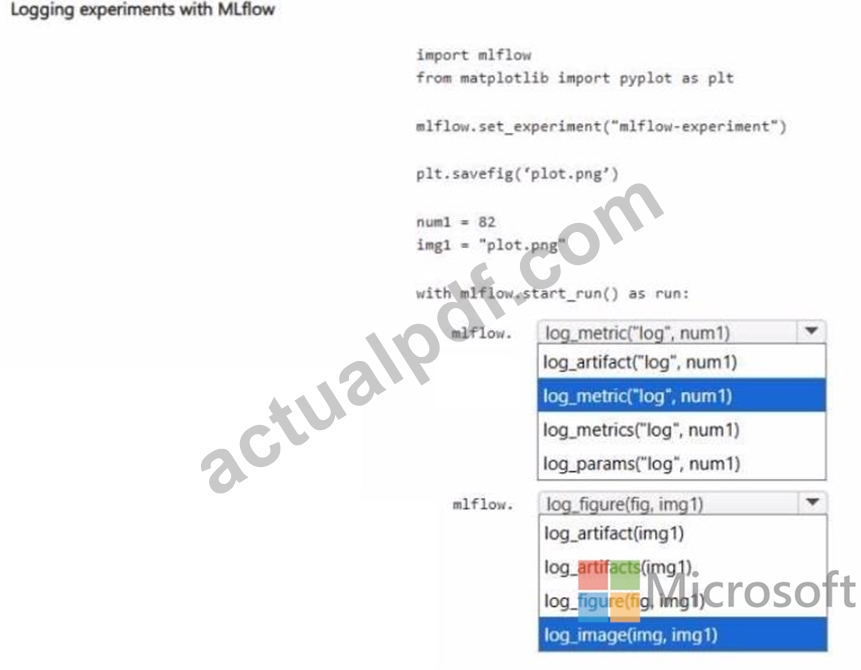
Answer:
Explanation:
NEW QUESTION # 313
You manage an Azure Machine Learning workspace named workspace1.
You must develop Python SDK v2 code to add a compute instance to workspace1. The code must import all required modules and call the constructor of the ComputeInstance class.
You need to add the instantiated compute instance to workspace1.
What should you use?
- A. set_resources method of an instance of the azure.ai.ml.Command class
- B. constructor of the azure.ai.ml.ComputeSchedule class
- C. begin_create_or_update method of an instance of the azure.ai.ml.MLCIient class
- D. constructor of the azure.ai.ml.ComputePowerAction enum
Answer: C
NEW QUESTION # 314
You are building a binary classification model by using a supplied training set.
The training set is imbalanced between two classes.
You need to resolve the data imbalance.
What are three possible ways to achieve this goal? Each correct answer presents a complete solution NOTE:
Each correct selection is worth one point.
- A. Use accuracy as the evaluation metric of the model.
- B. Resample the data set using under sampling or oversampling
- C. Penalize the classification
- D. Normalize the training feature set.
- E. Generate synthetic samples in the minority class.
Answer: A,B,C
Explanation:
Explanation
References:
https://machinelearningmastery.com/tactics-to-combat-imbalanced-classes-in-your-machine-learning-dataset/
NEW QUESTION # 315
You create a new Azure Databricks workspace.
You configure a new cluster for long-running tasks with mixed loads on the compute cluster as shown in the image below.
Use the drop-down menus to select the answer choice that completes each statement based on the information presented in the graphic.
NOTE: Each correct selection is worth one point.
Answer:
Explanation:
Reference:
https://docs.databricks.com/clusters/configure.html
NEW QUESTION # 316
Hotspot Question
You are developing code to analyze a dataset that includes age information for a large group of diabetes patients. You create an Azure Machine Learning workspace and install all required libraries. You set the privacy budget to 1.0.
You must analyze the dataset and preserve data privacy. The code must run twice before the privacy budget is depleted.
You need to complete the code.
Which values should you use? To answer, select the appropriate options in the answer area.
NOTE: Each correct selection is worth one point.
Answer:
Explanation:
NEW QUESTION # 317
You need to produce a visualization for the diagnostic test evaluation according to the data visualization requirements.
Which three modules should you recommend be used in sequence? To answer, move the appropriate modules from the list of modules to the answer area and arrange them in the correct order.
Answer:
Explanation:
Explanation
Step 1: Sweep Clustering
Start by using the "Tune Model Hyperparameters" module to select the best sets of parameters for each of the models we're considering.
One of the interesting things about the "Tune Model Hyperparameters" module is that it not only outputs the results from the Tuning, it also outputs the Trained Model.
Step 2: Train Model
Step 3: Evaluate Model
Scenario: You need to provide the test results to the Fabrikam Residences team. You create data visualizations to aid in presenting the results.
You must produce a Receiver Operating Characteristic (ROC) curve to conduct a diagnostic test evaluation of the model. You need to select appropriate methods for producing the ROC curve in Azure Machine Learning Studio to compare the Two-Class Decision Forest and the Two-Class Decision Jungle modules with one another.
References:
http://breaking-bi.blogspot.com/2017/01/azure-machine-learning-model-evaluation.html
NEW QUESTION # 318
You need to use the Python language to build a sampling strategy for the global penalty detection models.
How should you complete the code segment? To answer, select the appropriate options in the answer area.
NOTE: Each correct selection is worth one point.
Answer:
Explanation:
Reference:
https://github.com/pytorch/pytorch/blob/master/torch/utils/data/distributed.py
NEW QUESTION # 319
......
DP-100 Certification Exam Dumps Questions in here: https://drive.google.com/open?id=1dzQMFw-BLfyDpzoGEL5Opl9fxNDdF2Vr
Pass Your DP-100 Exam Easily with Accurate PDF Questions: https://www.actualpdf.com/DP-100_exam-dumps.html
