

Pass Exam Questions Efficiently With NS0-603 Questions (2023)
NS0-603 Questions - Truly Beneficial For Your Network Appliance Exam
The NS0-603 exam measures your ability to design and implement hybrid cloud solutions using NetApp technologies. The exam covers a wide range of topics such as NetApp ONTAP, NetApp HCI, NetApp Cloud Volumes Service, NetApp Cloud Insights, NetApp Kubernetes Service, and NetApp Cloud Manager. To pass the exam, you need to have a deep understanding of these technologies and their capabilities, as well as the ability to design and implement hybrid cloud solutions that meet the business requirements of your organization.
The Network Appliance NS0-603: NetApp Certified Hybrid Cloud - Architect exam is designed to assess the skill set of candidates in architecting hybrid cloud solutions that leverage both cloud and on-premises infrastructure. The exam tests various technical areas that are essential for designing and implementing hybrid cloud solutions using NetApp technologies such as ONTAP, Cloud Volumes ONTAP, and NetApp HCI.
NEW QUESTION # 18
You are designing a new deployment of Cloud Volumes ONTAP in Azure using a highly available configuration.
In this scenario, which two statements are true? (Choose two.)
- A. Each node has access to the other node's storage.
- B. NFSv4 is supported.
- C. NFSv4 is not supported.
- D. Each node has access to its own storage only.
Answer: B,C
NEW QUESTION # 19
You are designing a new hybrid cloud solution. The nonfunctional requirements state that you must be able to integrate identity management for SSO authentication.
In this scenario, what are two supported identity management providers? (Choose two.)
- A. Azure Active Directory
- B. YAML
- C. OAuth
- D. SAML
Answer: C,D
NEW QUESTION # 20
One volume on your NetApp Cloud Volumes ONTAP Hlgh-Availablllty (HA) cluster has reached a capacity limit.
Which two actions would address this issue? (Choose two.)
- A. Move volumes to another aggregate on the same system.
- B. Create another storage virtual machine (SVM) on your Cloud Volumes ONTAP node.
- C. Move volumes to another Cloud Volumes ONTAP system.
- D. Migrate aggregates to the standby node in your Cloud Volumes ONTAP cluster.
Answer: A,D
NEW QUESTION # 21
A company realizes that multiple departments are using different cloud providers for mission-critical workloads. They are experiencing poor performance on workloads across different cloud providers and notice that there are deployment inconsistencies.
In this scenario, what are two ways to correct the problem? (Choose two.)
- A. Use storage services that can scale dynamically with workload demands.
- B. Use infrastructure as code (IaC) to ensure deployments satisfy design specifications.
- C. Consolidate data for applications into volumes on a single cloud provider.
- D. Ensure that all virtual machines use Reserved Instances to maximize performance.
Answer: A,C
NEW QUESTION # 22
You are deploying NetApp Cloud Volumes ONTAP to support a relational database workload. You must protect data from an intermittent loss of network connectivity to a single zone in a public cloud data center.
Which Cloud Volumes ONTAP feature accomplishes this ta
- A. intelligent cold-data tiering to object storage
- B. multi-zone high-availability (HA)
- C. ONTAP storage efficiencies
- D. end-to-end encryption
Answer: B
NEW QUESTION # 23
Exhibit.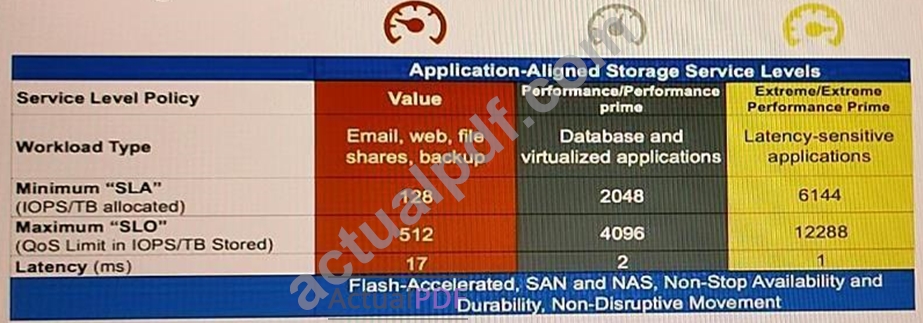
You are implementing storage-as-a-service using the service levels that are shown in the exhibit. In your implementation plan, which metric is used for the SLA and SLO?
- A. RAID level
- B. throughput
- C. I/O density
- D. latency
Answer: C
NEW QUESTION # 24
Your customer wants to demonstrate data privacy compliance by monitoring as many platforms as possible across on-premises and the public cloud with NetApp Cloud Data Sense (formerly Cloud Compliance).
In this scenario, which two data sources are supported? (Choose two.)
- A. Microsoft Exchange
- B. DB2
- C. Amazon S3
- D. Oracle Database
Answer: A,D
NEW QUESTION # 25
Exhibit.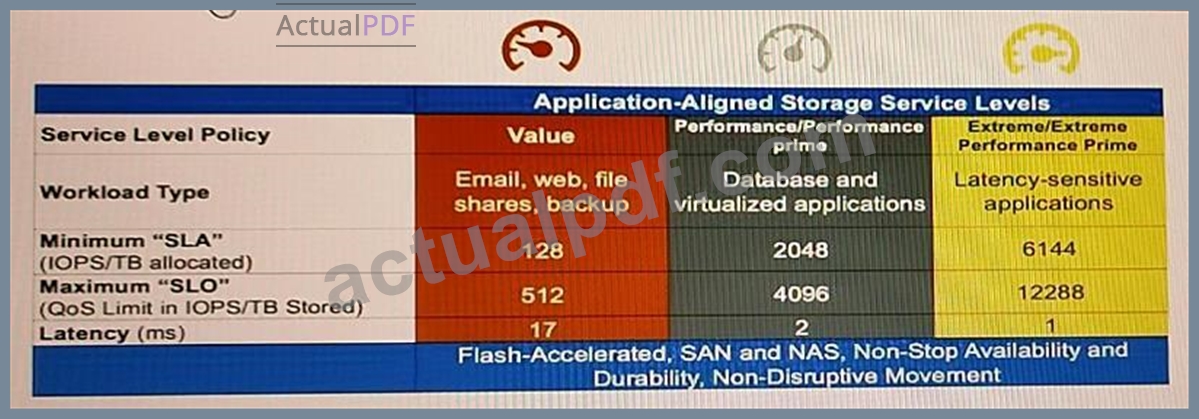
You are implementing storage-as-a-service using the service levels that are shown in the exhibit. In your implementation plan, which metric is used for the SLA and SLO?
- A. RAID level
- B. throughput
- C. I/O density
- D. latency
Answer: C
NEW QUESTION # 26
You are designing a solution that will use NetApp Cloud Volumes ONTAP for Azure. The deployment and ongoing management of the solution should be able to be automated.
In this scenario, which three automation methods would you include? (Choose three.)
- A. CloudFormation
- B. NetApp Manageability SDK
- C. Ansible
- D. ARM
- E. Rest API
Answer: A,B,C
NEW QUESTION # 27
Your log files are stored in Amazon S3 and you want to keep a copy In Azure Blob storage. In this scenario, which tool do you use for data replication?
- A. NetApp Cloud Backup service
- B. NetApp Cloud Sync service
- C. Azure Data Box
- D. AWS Snowball
Answer: B
NEW QUESTION # 28
You must back up data with an option to restore a file to the same or a different location.
In this scenario, which storage type would be used as part of the NetApp Cloud Backup service?
- A. block storage
- B. in-memory
- C. file storage
- D. object storage
Answer: D
NEW QUESTION # 29
You are planning a migration of a single 500 TB workload into NetApp Cloud Volumes ONTAP starting with
10 TB and gradually increasing the amount hosted in the cloud. You believe that 80% of the data is cold and will be tiered using data tiering. The most important factor is to minimize the number of licenses as your footprint grows.
Which two licensing options would minimize the cost of the licenses in this scenario? (Choose two.)
- A. Purchase a PAYGO license from the cloud marketplace for the initial footprint, and allow it to grow as your Cloud Volumes ONTAP instance grows.
- B. Purchase a single BYOL Cloud Volumes ONTAP license for the Initial footprint, and then deploy a new Cloud Volumes ONTAP instance for each additional migration.
- C. Purchase a BYOL license for the initial footprint, and then stack additional BYOL licenses when you reach capacity on the initial license.
- D. Purchase a PAYGO license from the cloud marketplace for the initial footprint, and then use in- place conversion to a BYOL license.
Answer: A,C
NEW QUESTION # 30
You are asked to develop a migration strategy for your customer that is migrating several SMB and NFS workloads from on-premises to Azure NetApp Files.
In this scenario, which three technologies should you consider? (Choose three.)
- A. NetApp Cloud Sync service
- B. robocopy
- C. SnapMirror technology
- D. Azure Storage Explorer
- E. rsync
Answer: A,B,D
NEW QUESTION # 31
Your organization is implementing an automation-first policy, requiring all code to be checked into a version-controlled repository. You are planning to deploy NetApp Cloud Volumes ONTAP for storage services in AWS.
In this scenario, how do you ensure that the NetApp solution satisfies your organization's requirements?
- A. Use the NetApp Cloud Manager Terraform provider to orchestrate Cloud Volumes ONTAP deployments.
- B. Use the Hashicorp Terraform registry to deploy Cloud Volumes ONTAP instances.
- C. Configure NetApp Cloud Manager to automatically export Cloud Volumes ONTAP configurations from Cloud Manager and save them into GitHub.
- D. Use AWS CloudFormation templates to deploy Cloud Volumes ONTAP instances.
Answer: A
NEW QUESTION # 32
You must consolidate your branch office Microsoft Windows file servers Into the cloud with the objective to centralize ail Microsoft Windows file shares (SMB) into your Active Directory domain. After analyzing your unstructured data set, you find that 10% of the data Is active and 90% of your data is archive data. You deploy NetApp Cloud Volumes ONTAP in Microsoft Azure and enable data tiering to tier off data to object storage, leaving all the defaults for the capacity tier.
In this scenario, by default, which storage class is used for your archive data?
- A. hot tier
- B. nearline storage class
- C. cool storage tier
- D. coldline storage class
Answer: C
NEW QUESTION # 33
Your organization requires you to consolidate your branch office Microsoft Windows file servers into the cloud with the objective to centralize all Microsoft Windows file shares (SMB) into your Active Directory domain. Your organization requires you to extend file shares from your Azure NetApp Files central data sources to your branch office workforce with support for file locking.
In this scenario, which NetApp cloud service provides the desired outcome?
- A. Cloud Tiering
- B. FlexCache technology
- C. ONTAP Select software
- D. Global File Cache
Answer: A
NEW QUESTION # 34
You are designing a disaster-recovery solution for a customer who is running a critical workload on Azure NetApp Files. You suggest cross-region replication In this scenario, which two statements are true? (Choose two.)
- A. Cross-region replication depends on Global VNet Peering.
- B. Cross-region replication can be used to replicate SMB workloads.
- C. Cross-region replication works only between designated region pairs.
- D. Cross-region replication can replicate data between any two Azure regions
Answer: B,D
NEW QUESTION # 35
......
Truly Beneficial For Your Network Appliance Exam: https://www.actualpdf.com/NS0-603_exam-dumps.html
