

N10-009 Practice Test Questions Updated 504 Questions
CompTIA N10-009 Dumps - Secret To Pass in First Attempt
CompTIA N10-009 Exam Syllabus Topics:
| Topic | Details |
|---|---|
| Topic 1 |
|
| Topic 2 |
|
| Topic 3 |
|
| Topic 4 |
|
| Topic 5 |
|
| Topic 6 |
|
NEW QUESTION # 187
While troubleshooting a VoIP handset connection, a technician's laptop is able to successfully connect to network resources using the same port. The technician needs to identify the port on the switch. Which of the following should the technician use to determine the switch and port?
- A. LLDP
- B. netstat
- C. IKE
- D. VLAN
Answer: A
Explanation:
Link Layer Discovery Protocol (LLDP) is a network protocol used for discovering devices and their capabilities on a local area network, primarily at the data link layer (Layer 2). It helps in identifying the connected switch and the specific port to which a device is connected. When troubleshooting a VoIP handset connection, the technician can use LLDP to determine the exact switch and port where the handset is connected. This protocol is widely used in network management to facilitate the discovery of network topology and simplify troubleshooting.
NEW QUESTION # 188
SIMULATION
You have been tasked with setting up a wireless network in an office. The network will consist of 3 Access Points and a single switch. The network must meet the following parameters:
The SSIDs need to be configured as CorpNet with a key of S3cr3t!
The wireless signals should not interfere with each other
The subnet the Access Points and switch are on should only support 30 devices maximum The Access Points should be configured to only support TKIP clients at a maximum speed INSTRUCTONS Click on the wireless devices and review their information and adjust the settings of the access points to meet the given requirements.
If at any time you would like to bring back the initial state of the simulation, please click the Reset All button.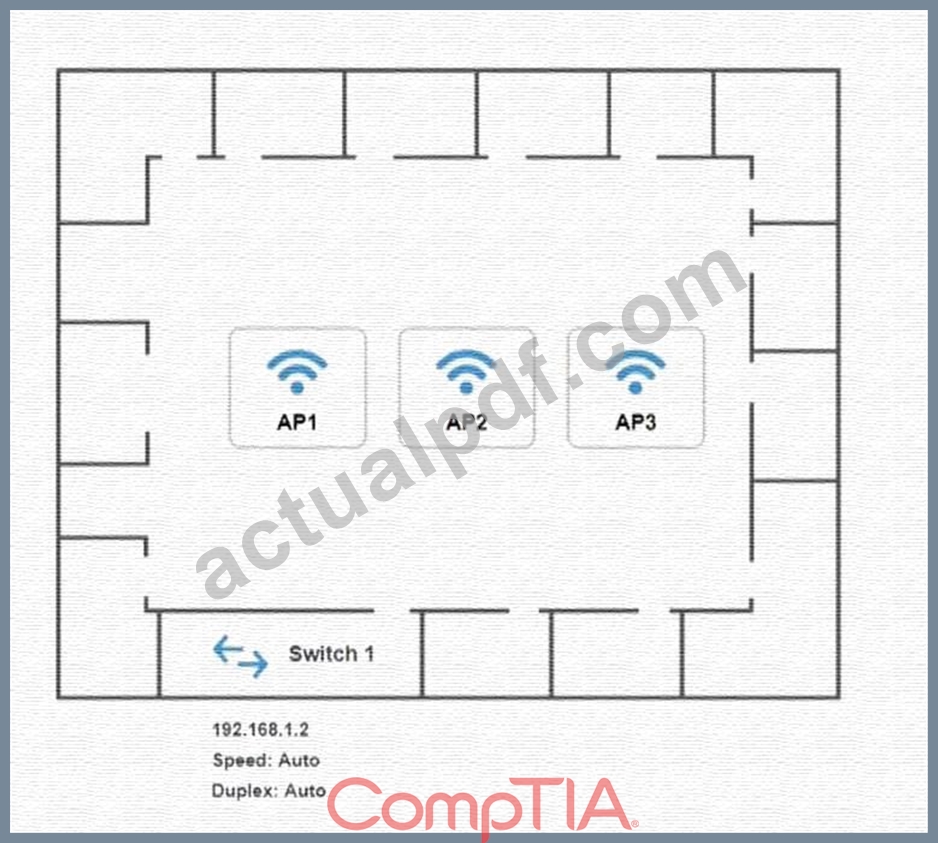
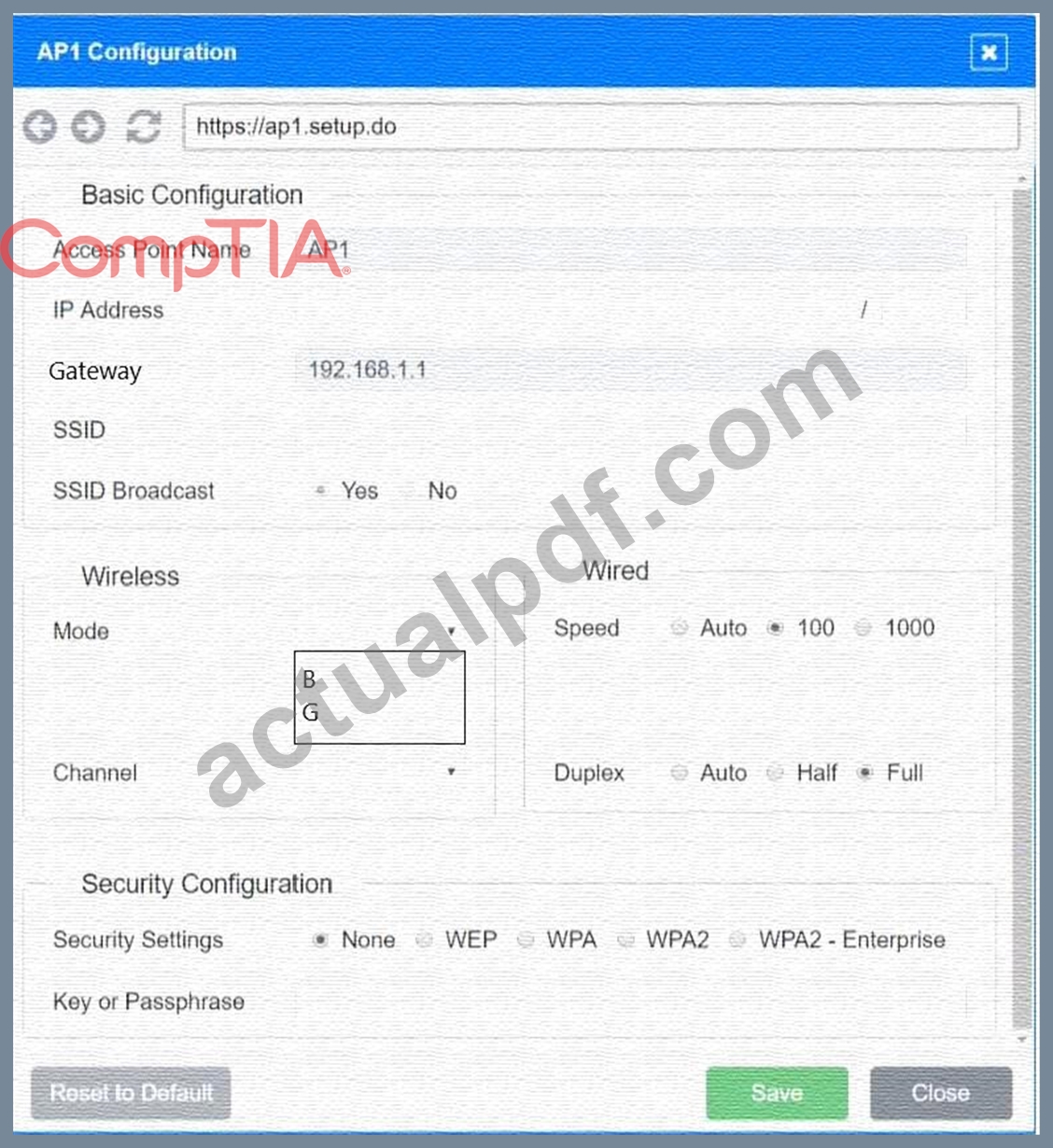
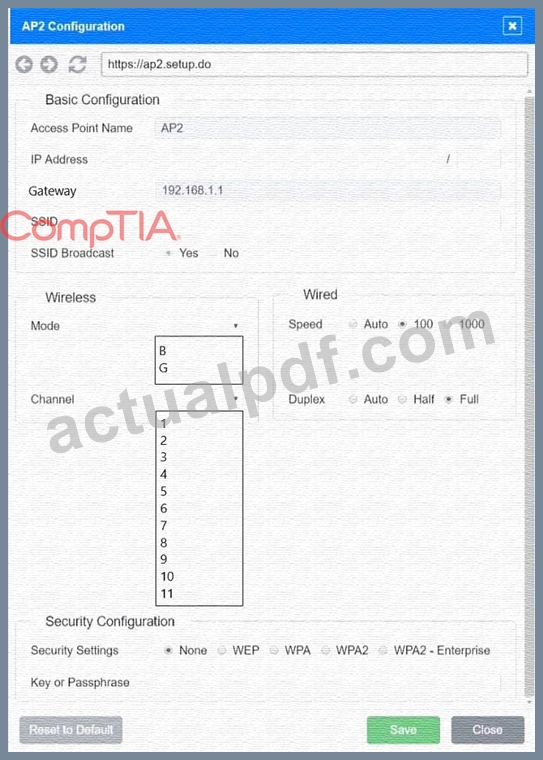
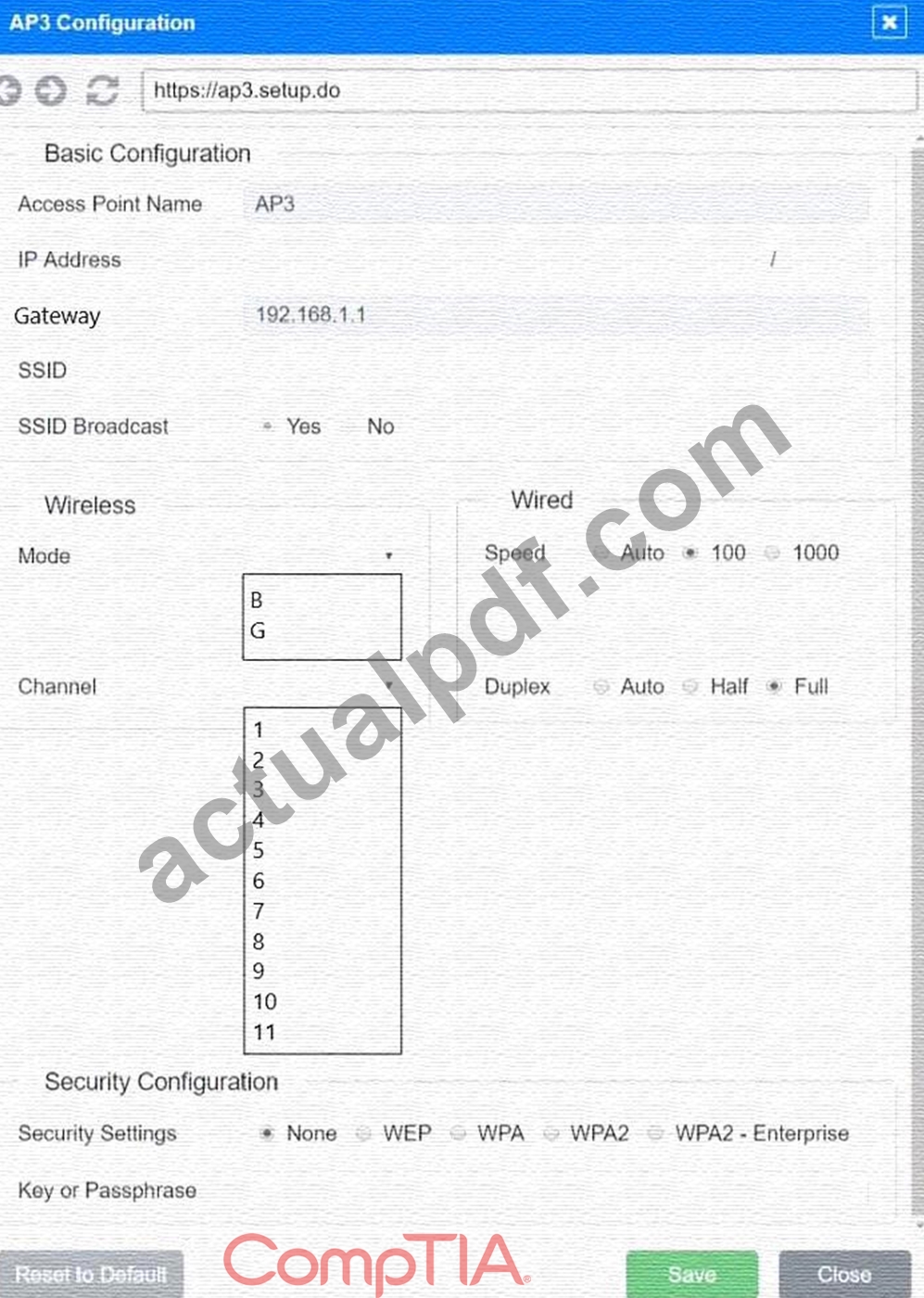
Answer:
Explanation:
See explanation below.
Explanation:
On the first exhibit, the layout should be as follows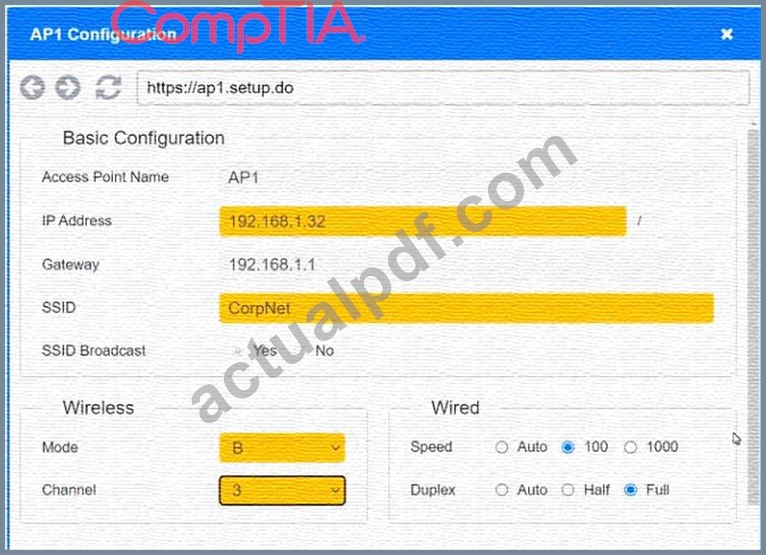
Graphical user interface, text, application, chat or text message Description automatically generated
Graphical user interface Description automatically generated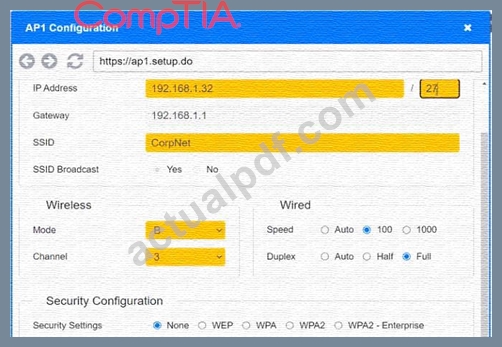
Graphical user interface, text, application, chat or text message Description automatically generated
Graphical user interface Description automatically generated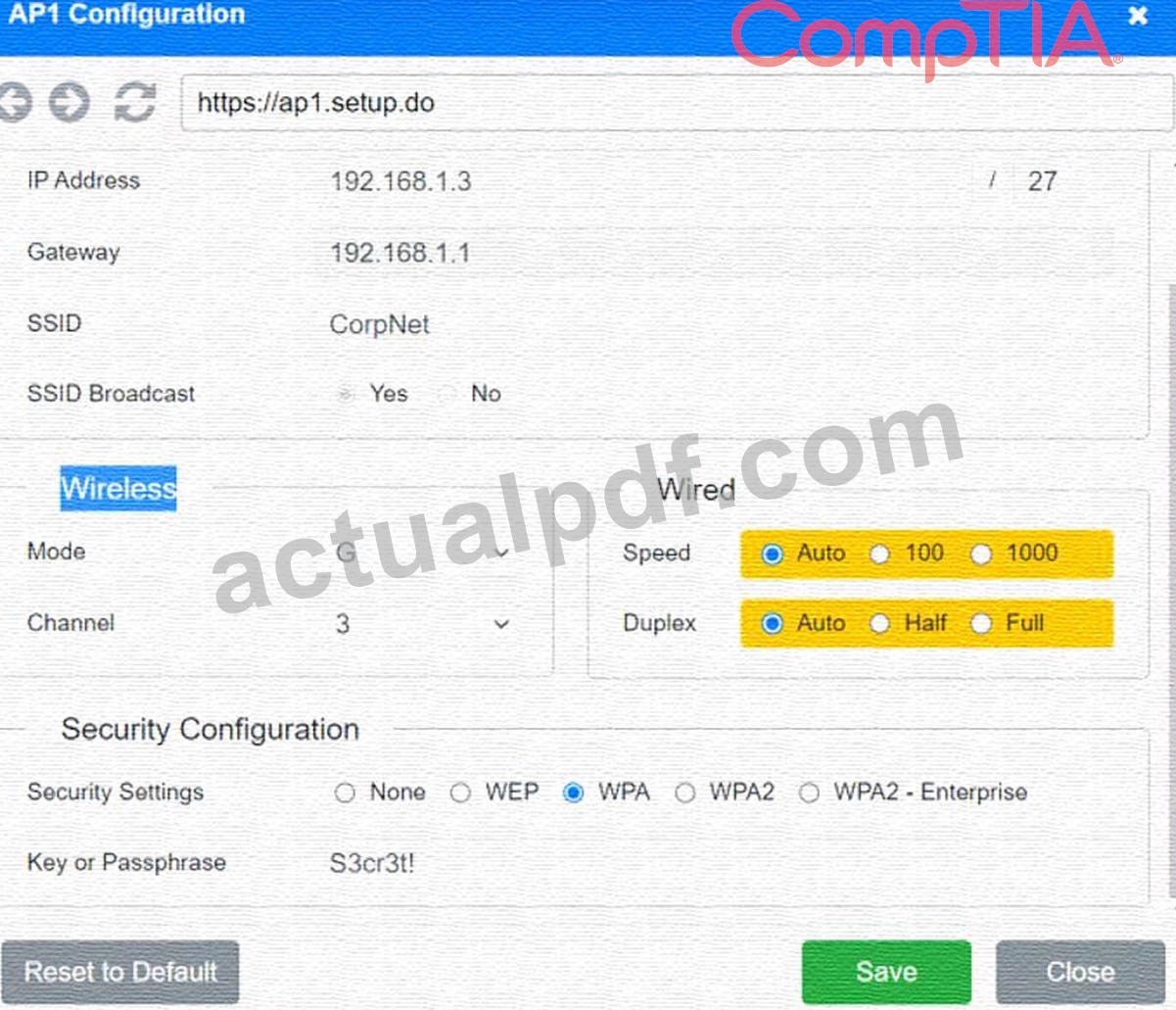
Exhibit 2 as follows
Access Point Name AP2
Graphical user interface Description automatically generated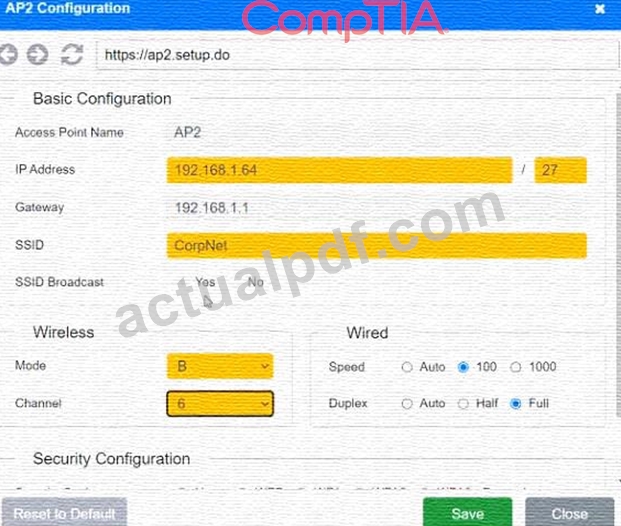
Graphical user interface, text, application, chat or text message Description automatically generated
Graphical user interface Description automatically generated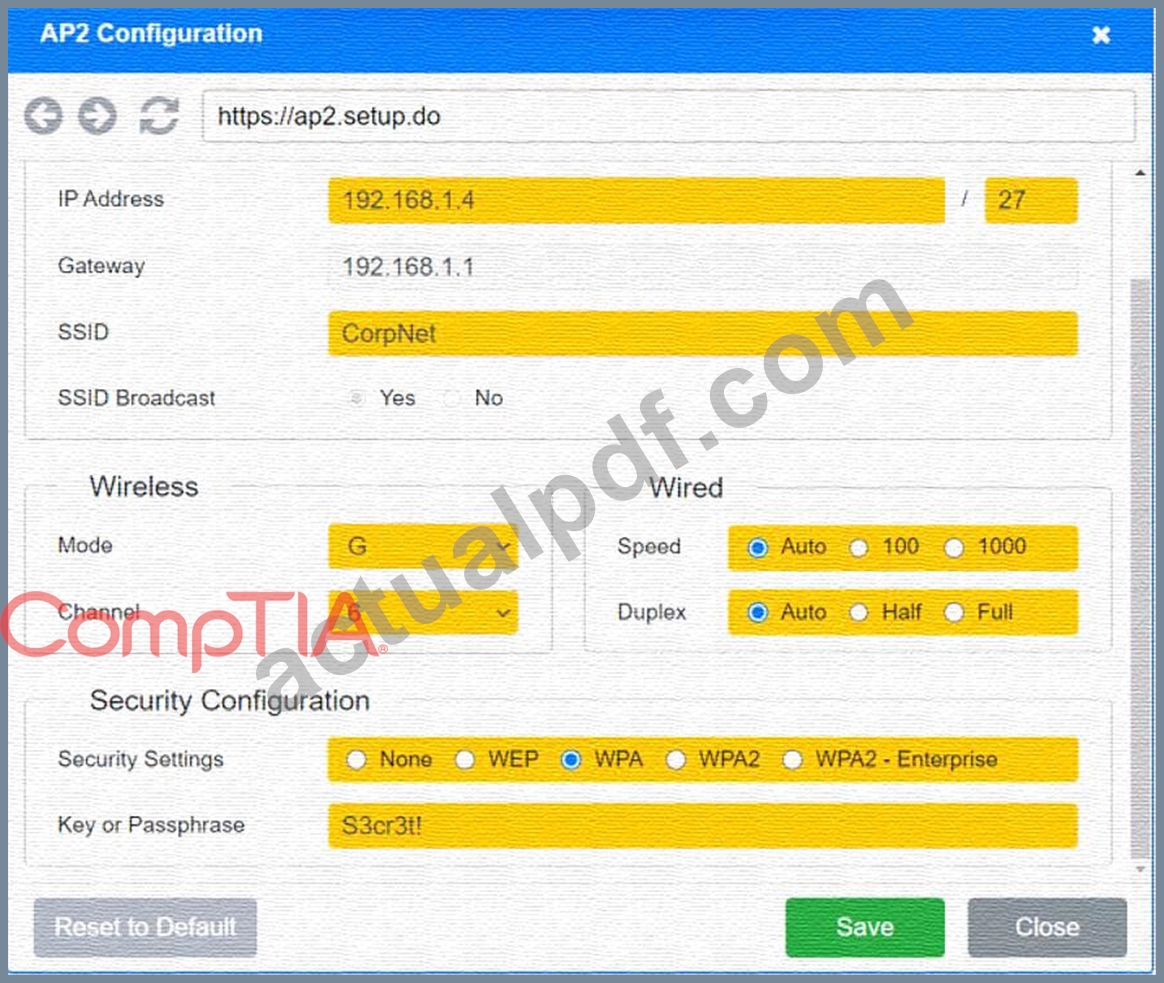
Exhibit 3 as follows
Access Point Name AP3
Graphical user interface Description automatically generated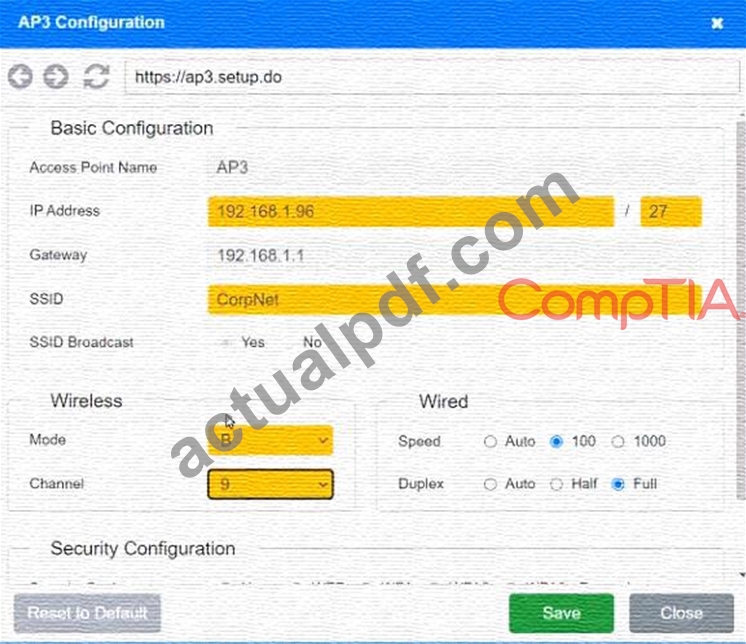
Graphical user interface, text, application, chat or text message Description automatically generated
Graphical user interface Description automatically generated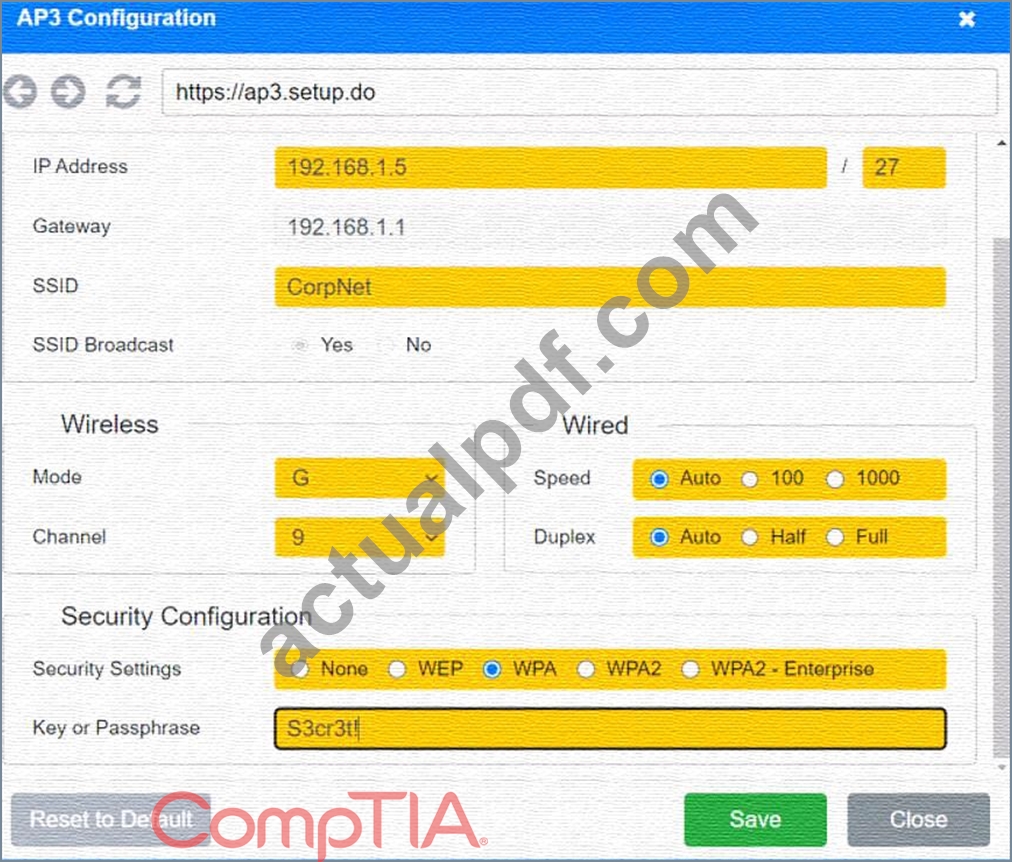
NEW QUESTION # 189
A user's home mesh wireless network is experiencing latency issues. A technician has:
*Performed a speed test.
*Rebooted the devices.
*Performed a site survey.
*Performed a wireless packet capture.
The technician reviews the following information:
The technician notices in the packet capture that frames were retransmitted. Which of the following is the most likely cause of the user's network issue?
- A. The devices are incompatible with the mesh network.
- B. The nodes are underpowered.
- C. The network has too much overlap.
- D. The SSIDs should not be the same.
Answer: C
Explanation:
*Too much overlap on the same channel (all devices on channel 11) causes interference, leading to retransmissions and high latency.
*Same SSIDs (A) are expected in mesh networks.
*Device compatibility (C) would show different symptoms.
*Node power (D) affects coverage, not congestion.
#Reference: CompTIA Network+ N10-009 Official Documentation - Wireless Troubleshooting & Signal Interference.
NEW QUESTION # 190
A network administrator is developing a method of device monitoring with the following requirements:
*Allows for explicit, by user, privilege management
*Includes centralized logging of changes
*Offers widely accessible remote management
*Provides support of service accounts
Which of the following will most closely meet these requirements?
- A. API
- B. SSO
- C. SNMP
- D. SIEM
Answer: A
Explanation:
*API (Application Programming Interface) enables secure and granular access control, remote management, and logging, making it ideal for network monitoring.
*SNMP (A) is mainly used for device monitoring but lacks centralized logging and user-based privilege control.
*SIEM (C) is a security monitoring tool focused on log collection, not device management.
*SSO (D) is related to authentication, not monitoring.
#Reference: CompTIA Network+ N10-009 Official Documentation - Network Monitoring & Management Technologies.
NEW QUESTION # 191
During a security audit, a consulting firm notices inconsistencies between the documentation and the actual environment. Which of the following can keep a record of who made the changes and what the changes are?
- A. Zero Trust
- B. Configuration monitoring
- C. Network access control
- D. Syslog
Answer: B
Explanation:
Configuration monitoring and management tools (often part of network management systems) maintain version-controlled records of device configurations, track changes, and log who made them. This provides accountability and supports compliance audits.
A . Network access control (NAC) manages endpoint access policies but does not track device config changes.
C . Zero Trust is a security framework requiring strict identity verification, not a configuration tracking tool.
D . Syslog collects system logs, but without a config monitoring system, it does not directly compare documentation to device state.
Reference (CompTIA Network+ N10-009):
Domain: Network Operations - Change management, configuration management, auditing.
NEW QUESTION # 192
A company's Chief Information Security Officer requires that servers and firewalls have accurate time stamps when creating log files so that security analysts can correlate events during incident investigations. Which of the following should be implemented?
- A. NTP
- B. Syslog server
- C. SMTP
- D. SNMP
Answer: A
Explanation:
The correct solution is NTP (Network Time Protocol). Accurate timestamps across servers, firewalls, and network devices are critical for correlating logs during incident response. NTP synchronizes device clocks to a trusted time source, ensuring consistency across the network.
A). Syslog centralizes logs but does not synchronize time.
B). SMTP is email transfer, unrelated to time.
D). SNMP monitors devices but does not correct time discrepancies.
By implementing NTP, analysts can ensure that logs from different devices are time-aligned, which is essential for reconstructing attack timelines and detecting anomalies.
References (CompTIA Network+ N10-009):
Domain: Network Operations - Time synchronization, NTP, log correlation.
NEW QUESTION # 193
A network technician needs to resolve some issues with a customer's SOHO network.
The customer reports that some of the devices are not connecting to the network, while others appear to work as intended.
INSTRUCTIONS
Troubleshoot all the network components and review the cable test results by Clicking on each device and cable.
Diagnose the appropriate component(s) by identifying any components with a problem and recommend a solution to correct each problem.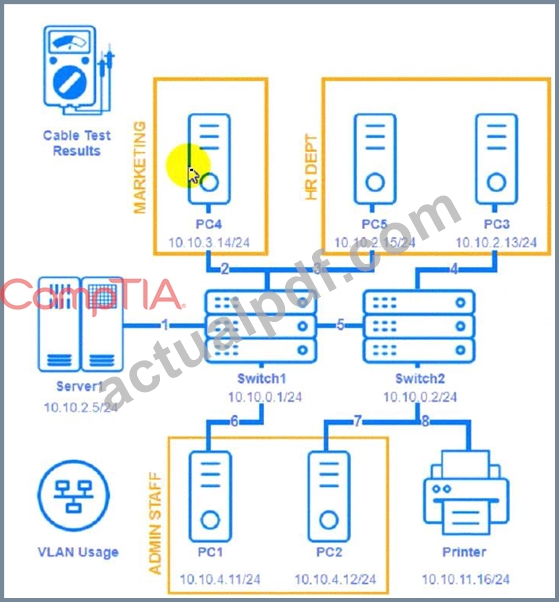
Cable Test Results:
Cable 1: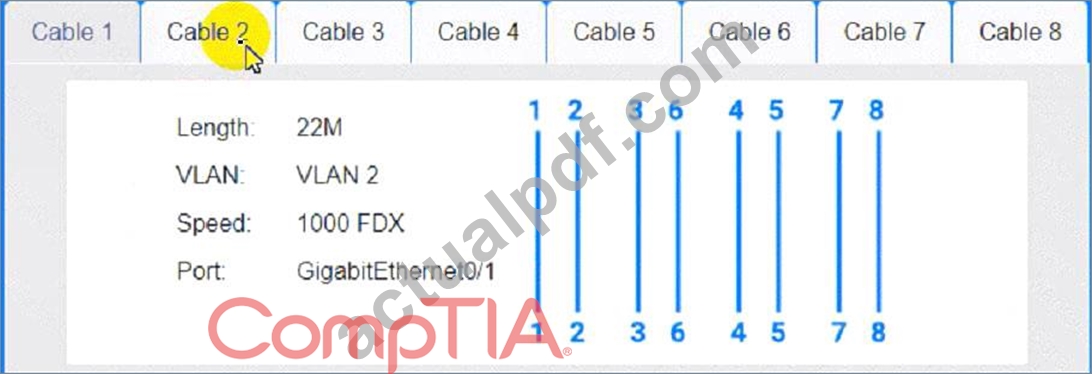
Cable 2: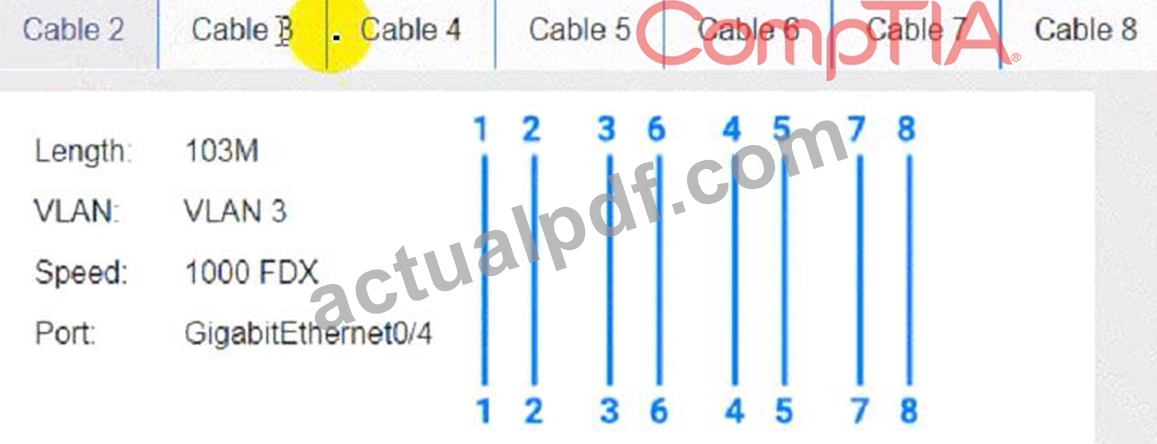
Cable 3: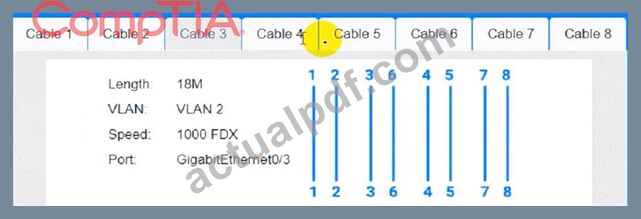
Cable 4: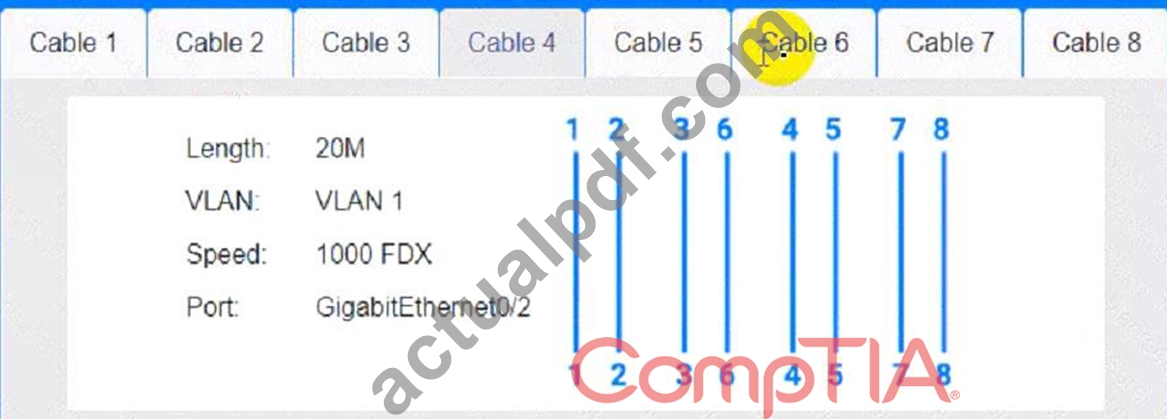
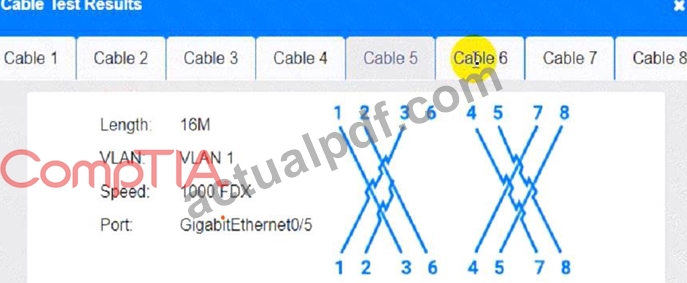
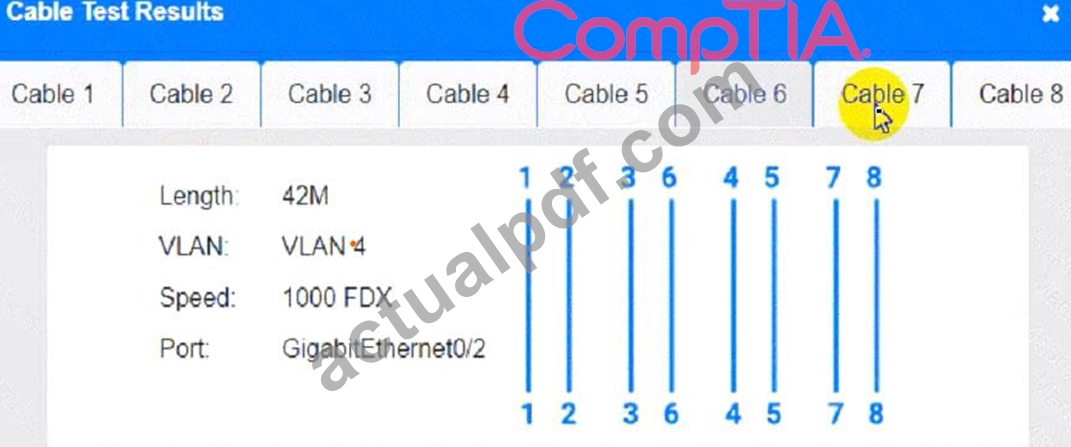
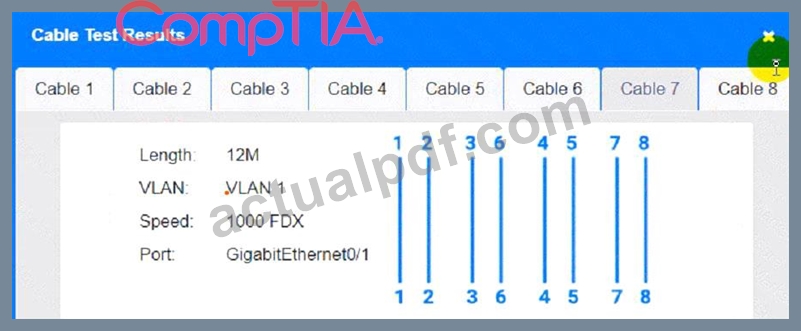
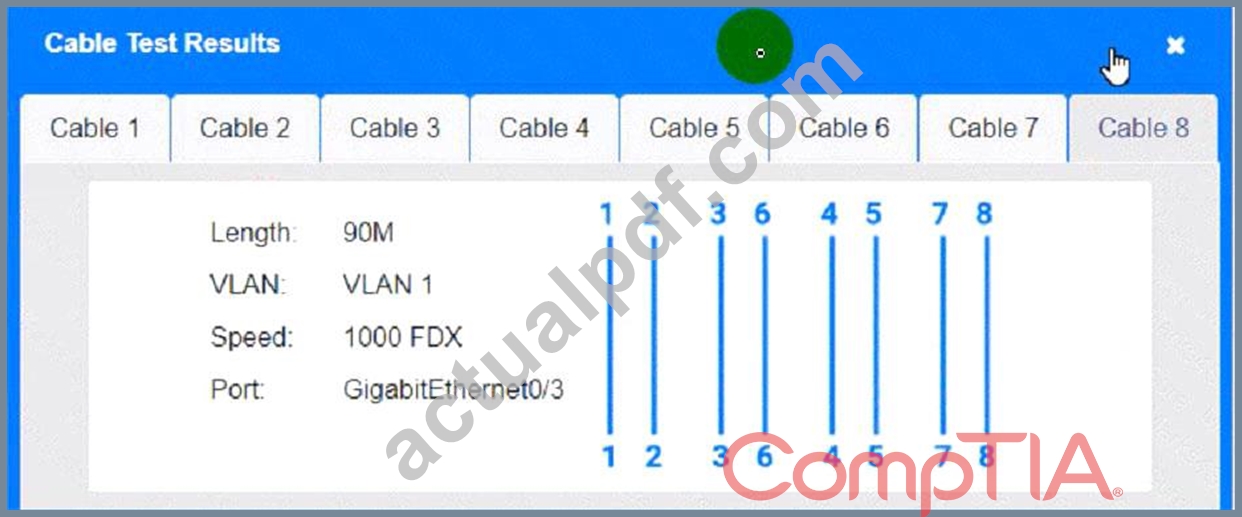
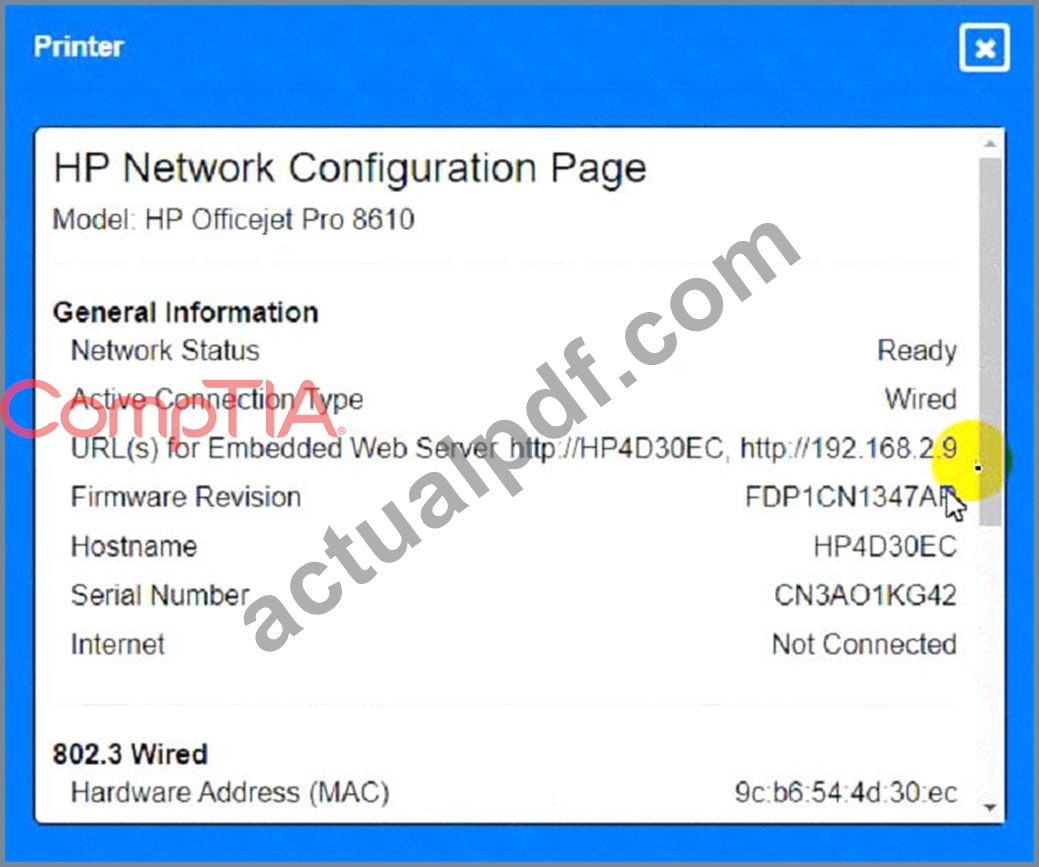
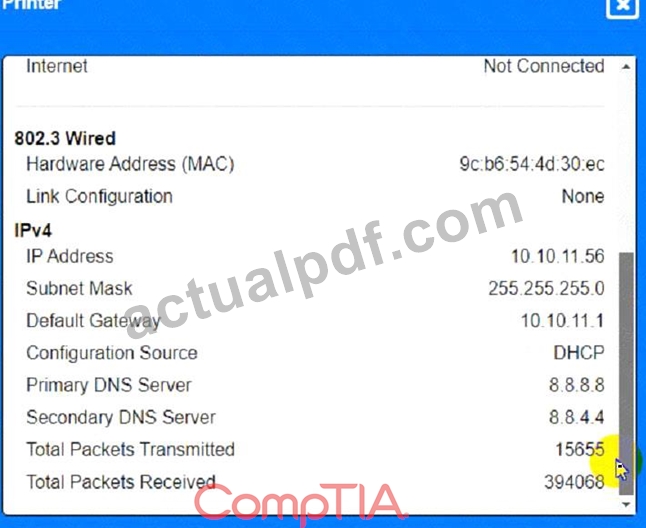
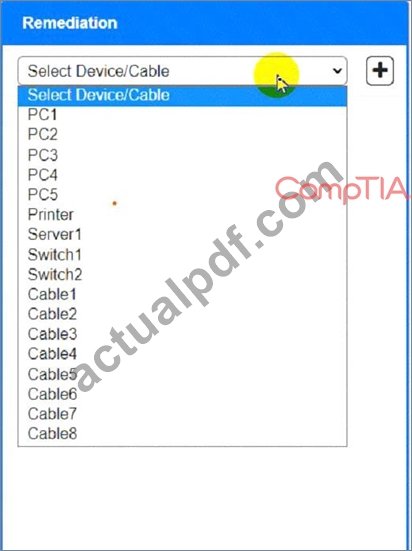
Answer:
Explanation:
See the Explanation for detailed information on this simulation.
Explanation:
(Note: Ips will be change on each simulation task, so we have given example answer for the understanding) To troubleshoot all the network components and review the cable test results, you can use the following steps:
* Click on each device and cable to open its information window.
* Review the information and identify any problems or errors that may affect the network connectivity or performance.
* Diagnose the appropriate component(s) by identifying any components with a problem and recommend a solution to correct each problem.
* Fill in the remediation form using the drop-down menus provided.
Here is an example of how to fill in the remediation form for PC1:
* The component with a problem is PC1.
* The problem is Incorrect IP address.
* The solution is Change the IP address to 192.168.1.10.
You can use the same steps to fill in the remediation form for other components.
To enter commands in each device, you can use the following steps:
* Click on the device to open its terminal window.
* Enter the command ipconfig /all to display the IP configuration of the device, including its IP address, subnet mask, default gateway, and DNS servers.
* Enter the command ping <IP address> to test the connectivity and reachability to another device on the network by sending and receiving echo packets. Replace <IP address> with the IP address of the destination device, such as 192.168.1.1 for Core Switch 1.
* Enter the command tracert <IP address> to trace the route and measure the latency of packets from the device to another device on the network by sending and receiving packets with increasing TTL values.
Replace <IP address> with the IP address of the destination device, such as 192.168.1.1 for Core Switch 1.
Here is an example of how to enter commands in PC1:
* Click on PC1 to open its terminal window.
* Enter the command ipconfig /all to display the IP configuration of PC1. You should see that PC1 has an incorrect IP address of 192.168.2.10, which belongs to VLAN 2 instead of VLAN 1.
* Enter the command ping 192.168.1.1 to test the connectivity to Core Switch 1. You should see that PC1 is unable to ping Core Switch 1 because they are on different subnets.
* Enter the command tracert 192.168.1.1 to trace the route to Core Switch 1. You should see that PC1 is unable to reach Core Switch 1 because there is no route between them.
You can use the same steps to enter commands in other devices, such as PC3, PC4, PC5, and Server 1.
NEW QUESTION # 194
Anetwork technicianis troubleshooting afaulty NICandtests the theory. Which of the following should the techniciando next?
- A. Implement the solution.
- B. Document the findings.
- C. Develop a theory.
- D. Establish a plan of action.
Answer: A
Explanation:
Comprehensive and Detailed Explanation:
Once thetheory has been tested and confirmed, the next step is toimplement the solutionbased on the CompTIA troubleshooting model.
CompTIA Troubleshooting Model:
* Identify the problem.
* Establish a theory of probable cause.
* Test the theory.
* Establish a plan of action and implement the solution.#(Correct step)
* Verify full system functionality.
* Document findings, actions, and outcomes.
Breakdown of Options:
* A. Develop a theory- The theory hasalready been developed and tested.
* B. Establish a plan of action- This happensbefore implementation, but since the issue isconfirmed, it's time to act.
* C. Implement the solution-Correct answer.The problem is confirmed, so the fix should be applied.
* D. Document the findings- Documentation is thefinal step, not the next one.
NEW QUESTION # 195
Which of the following technologies are X.509 certificates most commonly associated with?
- A. MFA
- B. LDAP
- C. VLAN tagging
- D. PKI
- E. 509 certificates are most commonly associated with Public Key Infrastructure (PKI). These certificates are used for a variety of security functions, including digital signatures, encryption, and authentication.
Answer: D
Explanation:
PKI: X.509 certificates are a fundamental component of PKI, used to manage encryption keys and authenticate users and devices.
Digital Certificates: They are used to establish secure communications over networks, such as SSL/TLS for websites and secure email communication.
Authentication and Encryption: X.509 certificates provide the means to securely exchange keys and verify identities in various applications, ensuring data integrity and confidentiality.
Network Reference:
CompTIA Network+ N10-007 Official Certification Guide: Covers PKI and the role of X.509 certificates in network security.
Cisco Networking Academy: Provides training on PKI, certificates, and secure communications.
Network+ Certification All-in-One Exam Guide: Explains PKI, X.509 certificates, and their applications in securing network communications.
NEW QUESTION # 196
A company receives a cease-and-desist order from its ISP regarding prohibited torrent activity. Which of the following should be implemented to comply with the cease-and-desist order?
- A. MAC security
- B. Screened subnet
- C. Content filtering
- D. Perimeter network
Answer: C
Explanation:
Content filtering can be used to block or restrict access to websites and services that facilitate torrenting and other prohibited activities. By implementing content filtering, the company can comply with the ISP's cease-and-desist order and prevent users from accessing torrent sites and engaging in prohibited activities.
Reference: CompTIA Network+ study materials.
NEW QUESTION # 197
Which of the following should a network administrator configure when adding OT devices to an organization's architecture?
- A. Honeynet
- B. Data-at-rest encryption
- C. Network segmentation
- D. Time-based authentication
Answer: C
NEW QUESTION # 198
Which of the following would most likely be used to implement encryption in transit when using HTTPS?
- A. RADIUS
- B. TLS
- C. SSH
- D. SCADA
Answer: B
Explanation:
Comprehensive and Detailed Explanation (paraphrased, aligned to N10-009):
HTTPS is HTTP encapsulated in TLS (the successor to SSL), which provides confidentiality, integrity, and server authentication for web traffic.
A . SSH secures remote shell and tunnels, not HTTPS.
C . SCADA refers to industrial control systems, not a transport security protocol.
D . RADIUS is an AAA protocol for authentication/authorization/accounting, not the web encryption layer.
Reference (CompTIA Network+ N10-009):
NEW QUESTION # 199
Which of the following allows a standard user to log in to multiple resources with one account?
- A. MFA
- B. RADIUS
- C. SSO
- D. TACACS+
Answer: C
Explanation:
Single Sign-On (SSO) enables a user to access multiple resources or applications with one set of credentials, improving usability and security. The document confirms:
"Single Sign-On (SSO) allows a user to authenticate once and gain access to multiple resources or applications without needing to log in again for each. It streamlines the login process and improves security by reducing the number of passwords that need to be managed."
NEW QUESTION # 200
A network administrator needs to monitor data from recently installed firewalls in multiple locations. Which of the following solutions would best meet the administrator's needs?
- A. IPS
- B. IDS
- C. SNMPv2
- D. SIEM
Answer: D
Explanation:
SIEM (Security Information and Event Management) systems are used to aggregate and analyze log data from various sources, including firewalls, to detect potential security incidents and assist in regulatory compliance. The document explains:
"SIEM solutions aggregate and analyze log and event data from multiple devices, including firewalls, across different locations. They help in real-time monitoring, incident response, and ensuring compliance with security policies."
NEW QUESTION # 201
Which of the following connectors allows a singular QSFP transceiver to have several physical connections?
- A. ST
- B. LC
- C. MPO
- D. RJ45
Answer: C
Explanation:
The MPO (Multi-fiber Push On) connector is designed to handle multiple fiber strands in a single connector, and it is commonly used with high-density transceivers like QSFP (Quad Small Form-factor Pluggable).
QSFP can support up to four channels (hence " quad " ), and MPO connectors can interface multiple fibers (e.
g., 8, 12, 24), making them ideal for 40Gbps or 100Gbps deployments.
RJ45 (A) is used for Ethernet over copper.
ST (B) and LC (C) are single-fiber connectors - they don ' t support the multi-fiber needs of QSFP setups.
# Therefore, MPO is the correct connector type for this use case.
Reference:CompTIA Network+ N10-009 Official Study Guide - Objective 3.1: " Compare and contrast different types of connectors and transceivers. "
NEW QUESTION # 202
Employees report that the network is slow. The network engineer thinks the performance issue is with an upstream router. Which of the following tools should the engineer use to determine the location of the issue?
- A. tcpdump and protocol analyzer
- B. tracert and ping
- C. Nmap and speed tester
- D. nslookup and dig
Answer: B
Explanation:
To determine where slowness is occurring-especially if an upstream router is suspected-the best tools are ping and tracert/traceroute. Network+ (N10-009) troubleshooting objectives emphasize using these to test connectivity, latency, and the path packets take through the network. Ping measures reachability and round- trip time; rising latency or packet loss can indicate congestion or a failing link/device. Tracert identifies each hop along the route and reports per-hop response times, helping pinpoint whether delays begin at a specific hop (for example, the default gateway, the upstream router, or a provider edge). This allows the engineer to localize the problem area and decide whether the issue is internal, at the upstream router, or beyond.
nslookup and dig are DNS tools; they diagnose name resolution, not general network slowness location.
Nmap focuses on scanning ports/hosts, and a "speed tester" measures throughput but does not locate the failing hop. tcpdump and protocol analyzer can reveal retransmissions, windowing, or application behavior, but they are not the fastest first-choice tools for locating an upstream routing/performance bottleneck across hops. Hence, tracert and ping are the correct pair.
NEW QUESTION # 203
A major natural disaster strikes a company's headquarters, causing significant destruction and data loss. The company needs to quickly recover and resume operations. Which of the following will a network administrator need to do first?
- A. Conduct a damage assessment
- B. Establish a communication plan
- C. Migrate to the cold site
- D. Notify customers of the disaster
Answer: A
Explanation:
In disaster recovery, the first step after an incident is to conduct a thorough damage assessment to understand the extent of the damage and determine the next appropriate steps. This allows for informed decision-making during the recovery process. The document says:
"The first step after a disaster is to conduct a damage assessment. This involves evaluating the extent of damage to equipment, infrastructure, and data, forming the foundation for recovery efforts and prioritizing response actions."
NEW QUESTION # 204
Which of the following is the most likely benefit of installing server equipment in a rack?
- A. Simplified troubleshooting process
- B. Decreased power consumption
- C. Improved network performance
- D. Increased compute density
Answer: D
Explanation:
Installing server equipment in a rack increases compute density by allowing multiple servers to be organized efficiently in a vertical configuration, saving space while housing more devices in a smaller footprint. This is critical for data centers and businesses with high hardware demands.
Simplified troubleshooting process (A): While racks can aid in organizing equipment, this is a secondary benefit, not the primary purpose.
Decreased power consumption (B): Rack installation does not directly reduce power usage; equipment power consumption remains the same.
Improved network performance (C): Racking servers does not inherently improve network performance; that depends on network configurations.
Reference: CompTIA Network+ Official Study Guide, Domain 1.3 (Rack Installations).
NEW QUESTION # 205
A network engineer is now in charge of all SNMP management in the organization. The engineer must use a SNMP version that does not utilize plaintext data. Which of the following is the minimum version of SNMP that supports this requirement?
- A. v1
- B. v3
- C. v2u
- D. v2c
Answer: B
Explanation:
SNMPv3 is the version of the Simple Network Management Protocol that introduces security enhancements, including message integrity, authentication, and encryption. Unlike previous versions (v1 and v2c), SNMPv3 supports encrypted communication, ensuring that data is not transmitted in plaintext. This provides confidentiality and protects against eavesdropping and unauthorized access.References:CompTIA Network+ study materials.
NEW QUESTION # 206
An administrator is configuring a switch that will be placed in an area of the office that is accessible to customers. Which of the following is the best way for the administrator to mitigate unknown devices from connecting to the network?
- A. ACL
- B. 802.1x
- C. Perimeter network
- D. SSE
Answer: B
Explanation:
802.1x is a network access control protocol that provides an authentication mechanism to devices trying to connect to a LAN or WLAN. This ensures that only authorized devices can access the network, making it ideal for mitigating the risk of unknown devices connecting to the network, especially in accessible areas.
802.1x Authentication: Requires devices to authenticate using credentials (e.g., username and password, certificates) before gaining network access.
Access Control: Prevents unauthorized devices from connecting to the network, enhancing security in public or semi-public areas.
Implementation: Typically used in conjunction with a RADIUS server to manage authentication requests.
NEW QUESTION # 207
Several users in an organization report connectivity issues and lag during a video meeting. The network administrator performs a tcpdump and observes increased retransmissions for other non-video applications on the network. Which of the following symptoms describes the users' reported issues?
- A. Packet loss
- B. Bottlenecking
- C. Jitter
- D. Latency
Answer: A
Explanation:
Comprehensive and Detailed In-Depth Explanation:
Packet loss occurs when network packets fail to reach their destination, leading to disruptions in connectivity and performance issues. In this scenario:
* Users report connectivity issues and lag during video meetings.
* The administrator detects increased retransmissions in tcpdump, which is a strong indicator of lost packets that must be resent.
* Video meetings are particularly sensitive to packet loss, leading to buffering, frozen screens, and dropped calls.
Latency (Option A) refers to delayed data transmission but does not necessarily cause retransmissions.
Bottlenecking (Option C) happens when a network component (e.g., router, switch) cannot handle the traffic load, but packet retransmissions are more directly related to packet loss.Jitter (Option D) affects the consistency of packet arrival times, but the symptoms described here are more aligned with packet loss rather than timing variations.
? Reference: CompTIA Network+ (N10-009) Official Study Guide - Section: Troubleshooting Connectivity Issues
NEW QUESTION # 208
A network engineer needs to correlate findings and receive alerts if there are brute force attacks, DDoS attacks, or port scanning happening within their network. Which of the following network monitoring technologies should the engineer implement?
- A. SIEM
- B. Packet capture
- C. SNMPv3
- D. Syslog collector
Answer: A
Explanation:
A SIEM (Security Information and Event Management) platform is built to collect, correlate, and alert on security-relevant events across many sources, which is exactly what's needed to identify patterns such as brute force attempts, port scanning, and DDoS indicators. In Network+ (N10-009) security operations concepts, correlation is key: a SIEM can ingest logs from firewalls, IDS/IPS, servers, authentication systems, endpoint agents, and network devices, then apply rules/analytics to detect suspicious behavior that might not be obvious from a single log source. It can also generate real-time alerts, dashboards, and incident timelines-helping the engineer respond quickly and prioritize threats.
Packet capture provides deep visibility into traffic but is not inherently designed for enterprise-wide correlation and alerting without significant additional tooling and expertise. SNMPv3 is used for secure device monitoring (status, counters, performance) rather than detecting coordinated attack patterns. A syslog collector centralizes logs but generally does not provide the same level of correlation, enrichment, and automated alerting capabilities as a SIEM. Therefore, SIEM is the best answer.
NEW QUESTION # 209
Which of the following network devices converts wireless signals to electronic signals?
- A. Access point
- B. Router
- C. Firewall
- D. Load balancer
Answer: A
Explanation:
Role of an Access Point (AP):
Wireless to Wired Conversion: An access point (AP) is a device that allows wireless devices to connect to a wired network using Wi-Fi. It converts wireless signals (radio waves) into electronic signals that can be understood by wired network devices.
Functionality:
Signal Conversion: The AP receives wireless signals from devices such as laptops, smartphones, and tablets, converts them into electronic signals, and transmits them over the wired network.
Connectivity: APs provide a bridge between wireless and wired segments of the network, enabling seamless communication.
Comparison with Other Devices:
Router: Directs traffic between different networks and may include built-in AP functionality but is not primarily responsible for converting wireless to electronic signals.
Firewall: Protects the network by controlling incoming and outgoing traffic based on security rules, not involved in signal conversion.
Load Balancer: Distributes network or application traffic across multiple servers to ensure reliability and performance, not involved in signal conversion.
Deployment:
APs are commonly used in environments where wireless connectivity is needed, such as offices, homes, and public spaces. They enhance mobility and provide flexible network access.
Reference:
CompTIA Network+ study materials on wireless networking and access points.
NEW QUESTION # 210
......
CompTIA N10-009 Exam Dumps [2026] Practice Valid Exam Dumps Question: https://www.actualpdf.com/N10-009_exam-dumps.html
N10-009 Dumps - Grab Out For [NEW-2026] CompTIA Exam: https://drive.google.com/open?id=1r62pAQtrXFTgxS5u0Fkc9SJq-nfYrTHP
