

Microsoft Azure AZ-400 Dumps | Updated Aug 28, 2021 - ActualPDF
Master 2021 Latest The Questions Microsoft Azure and Pass AZ-400 Real Exam!
NEW QUESTION 113
You need to configure a virtual machine named VM1 to securely access stored secrets in an Azure Key Vault named az400-11566895-kv.
To complete this task, sign in to the Microsoft Azure portal.
Answer:
Explanation:
See solution below.
Explanation
You can use a system-assigned managed identity for a Windows virtual machine (VM) to access Azure Key Vault.
* Sign in to Azure portal
* Locate virtual machine VM1.
* Select Identity
* Enable the system-assigned identity for VM1 by setting the Status to On.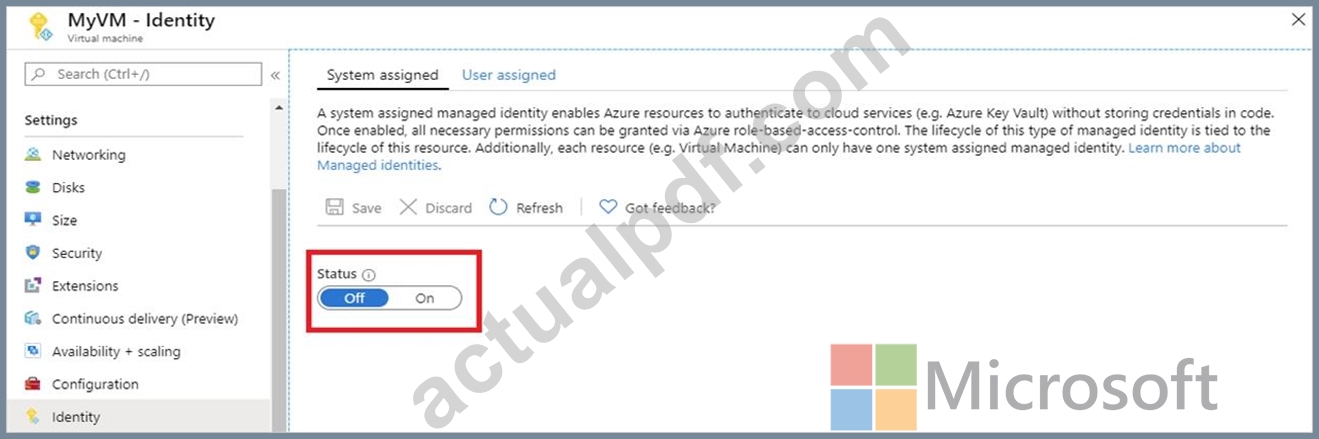
Note: Enabling a system-assigned managed identity is a one-click experience. You can either enable it during the creation of a VM or in the properties of an existing VM.
Reference:
https://docs.microsoft.com/en-us/azure/active-directory/managed-identities-azure-resources/tutorial-windows-vm
NEW QUESTION 114
Your company is creating a suite of three mobile applications.
You need to control access to the application builds. The solution must be managed at the organization level What should you use? To answer, select the appropriate options m the answer area.
NOTE: Each correct selection is worth one point.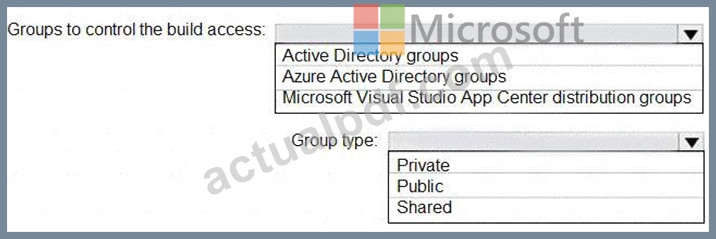
Answer:
Explanation: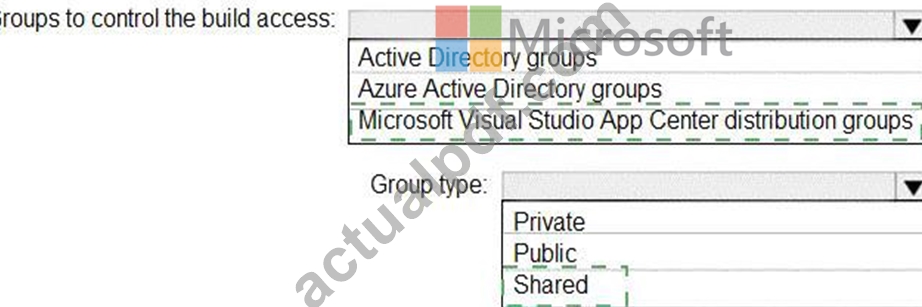
Explanation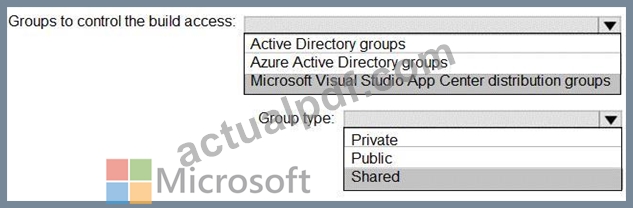
Box 1: Microsoft Visual Studio App Center distribution Groups
Distribution Groups are used to control access to releases. A Distribution Group represents a set of users that can be managed jointly and can have common access to releases. Example of Distribution Groups can be teams of users, like the QA Team or External Beta Testers or can represent stages or rings of releases, such as Staging.
Box 2: Shared
Shared distribution groups are private or public distribution groups that are shared across multiple apps in a single organization. Shared distribution groups eliminate the need to replicate distribution groups across multiple apps.
Note: With the Deploy with App Center Task in Visual Studio Team Services, you can deploy your apps from Azure DevOps (formerly known as VSTS) to App Center. By deploying to App Center, you will be able to distribute your builds to your users.
References: https://docs.microsoft.com/en-us/appcenter/distribution/groups
NEW QUESTION 115
You need to configure Azure Automation for the computer in Group7.
Which three actions should you perform in sequence? To answer, move the appropriate actions from the list of actions to the answer area and arrange them in the correct order.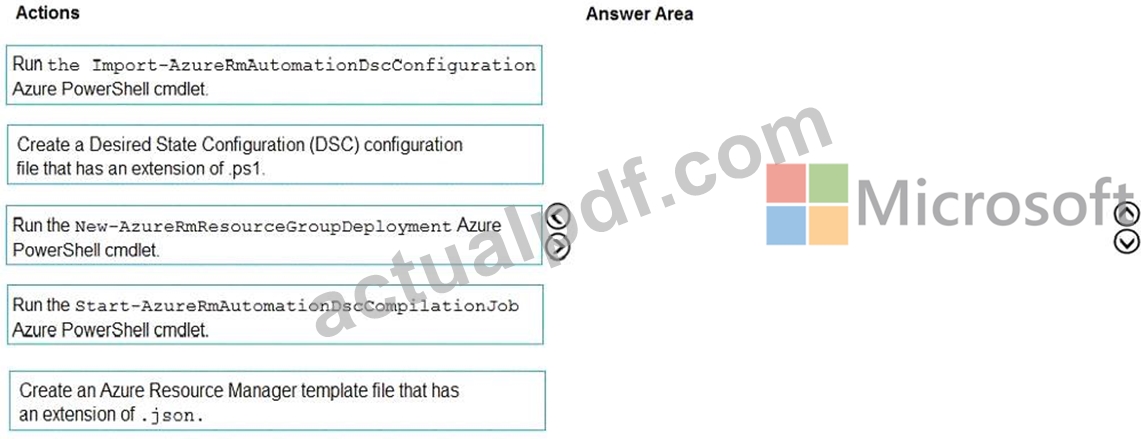
Answer:
Explanation: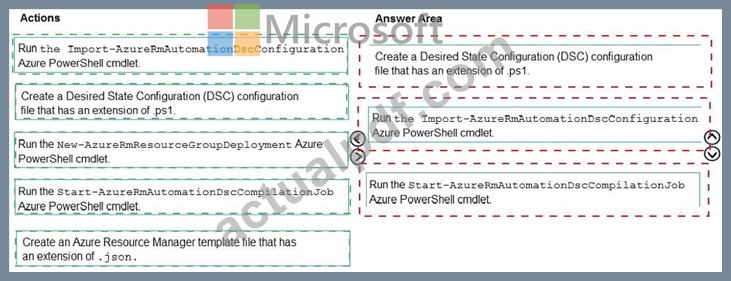
Explanation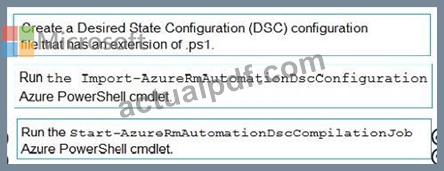
Step 1: Create a Desired State Configuration (DSC) configuration file that has an extension of .ps1.
Step 2: Run the Import-AzureRmAutomationDscConfiguration Azure Powershell cmdlet The Import-AzureRmAutomationDscConfiguration cmdlet imports an APS Desired State Configuration (DSC) configuration into Azure Automation. Specify the path of an APS script that contains a single DSC configuration.
Example:
PS C:\>Import-AzureRmAutomationDscConfiguration -AutomationAccountName
"Contoso17"-ResourceGroupName "ResourceGroup01" -SourcePath "C:\DSC\client.ps1" -Force This command imports the DSC configuration in the file named client.ps1 into the Automation account named Contoso17. The command specifies the Force parameter. If there is an existing DSC configuration, this command replaces it.
Step 3: Run the Start-AzureRmAutomationDscCompilationJob Azure Powershell cmdlet The Start-AzureRmAutomationDscCompilationJob cmdlet compiles an APS Desired State Configuration (DSC) configuration in Azure Automation.
References:
https://docs.microsoft.com/en-us/powershell/module/azurerm.automation/import-azurermautomationdscconfigur
https://docs.microsoft.com/en-us/powershell/module/azurerm.automation/start-azurermautomationdsccompilatio
NEW QUESTION 116
You plan to use Azure Kubernetes Service (AKS) to host containers deployed from images hosted in a Docker Trusted Registry.
You need to recommend a solution for provisioning and connecting to AKS. The solution must ensure that AKS is RBAC-enaWed and uses a custom service principal.
Which three commands should you recommend be run in sequence? To answer, move the appropriate commands from the list of commands to the answer area and arrange them in the coned order.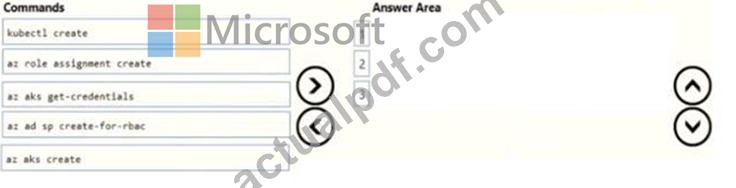
Answer:
Explanation: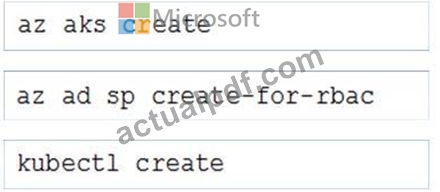
Step 1 : az acr create
An Azure Container Registry (ACR) can also be created using the new Azure CLI.
az acr create
--name <REGISTRY_NAME>
--resource-group <RESOURCE_GROUP_NAME>
--sku Basic
Step 2: az ad sp create-for-rbac
Once the ACR has been provisioned, you can either enable administrative access (which is okay for testing) or you create a Service Principal (sp) which will provide a client_id and a client_secret.
az ad sp create-for-rbac
--scopes
/subscriptions/<SUBSCRIPTION_ID>/resourcegroups/<RG_NAME>/providers/Microsoft.ContainerRegistry/re
--role Contributor
--name <SERVICE_PRINCIPAL_NAME>
Step 3: kubectl create
Create a new Kubernetes Secret.
kubectl create secret docker-registry <SECRET_NAME>
--docker-server <REGISTRY_NAME>.azurecr.io
--docker-email <YOUR_MAIL>
--docker-username=<SERVICE_PRINCIPAL_ID>
--docker-password <YOUR_PASSWORD>
References:
https://thorsten-hans.com/how-to-use-private-azure-container-registry-with-kubernetes
NEW QUESTION 117
You manage the Git repository for a large enterprise application.
You need to minimize the data size of the repository.
How should you complete the commands? To answer, select the appropriate options in the answer area.
NOTE: Each correct selection is worth one point.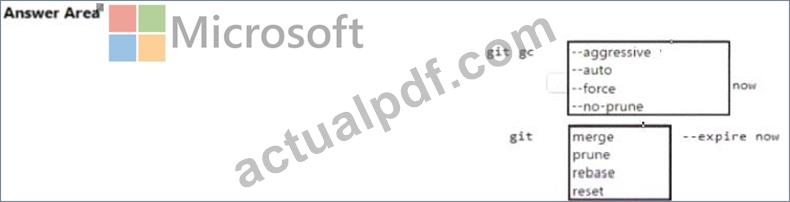
Answer:
Explanation: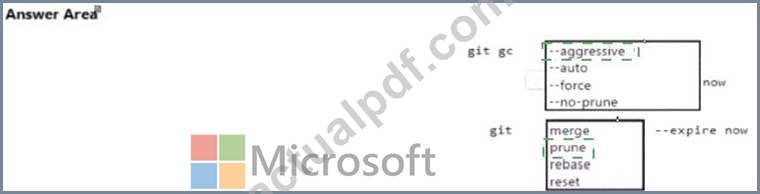
Explanation
Box 1: --aggressive
Cleanup unnecessary files and optimize the local repository:
git gc --aggressive
Box 2: prune
Prune all unreachable objects from the object database:
git prune
Reference:
https://gist.github.com/Zoramite/2039636
NEW QUESTION 118
You have a build pipeline in Azure Pipelines that uses different jobs to compile an application for 10 different architectures.
The build pipeline takes approximately one day to complete.
You need to reduce the time it takes to execute the build pipeline
Which two actions should you perform? Each correct answer presents part of the solution.
NOTE: Each correct selection is worth one point
- A. Move to a blue/green deployment pattern.
- B. Create an agent pool.
- C. Create a deployment group.
- D. Increase the number of parallel jobs.
- E. Reduce the size of the repository.
Answer: B,D
Explanation:
Explanation
Question: I need more hosted build resources. What can I do?
The Answer: The Azure Pipelines pool provides all Azure DevOps organizations with cloud-hosted build agents
and free build minutes each month. If you need more Microsoft-hosted build resources, or need to run more jobs in parallel, then you can either:
Host your own agents on infrastructure that you manage.
Buy additional parallel jobs.
Reference:
https://docs.microsoft.com/en-us/azure/devops/pipelines/agents/pools-queues
NEW QUESTION 119
Your company is creating a suite of three mobile applications.
You need to control access to the application builds. The solution must be managed at the organization level What should you use? To answer, select the appropriate options m the answer area.
NOTE: Each correct selection is worth one point.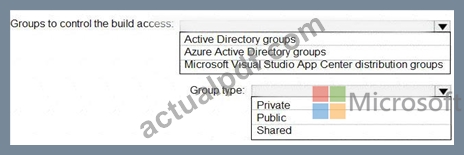
Answer:
Explanation: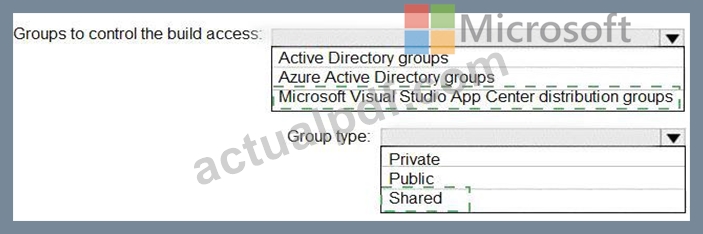
Explanation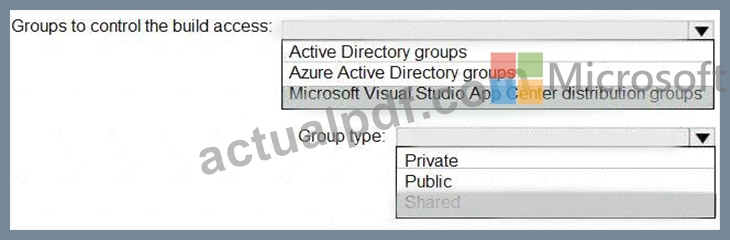
Box 1: Microsoft Visual Studio App Center distribution Groups
Distribution Groups are used to control access to releases. A Distribution Group represents a set of users that can be managed jointly and can have common access to releases. Example of Distribution Groups can be teams of users, like the QA Team or External Beta Testers or can represent stages or rings of releases, such as Staging.
Box 2: Shared
Shared distribution groups are private or public distribution groups that are shared across multiple apps in a single organization. Shared distribution groups eliminate the need to replicate distribution groups across multiple apps.
Note: With the Deploy with App Center Task in Visual Studio Team Services, you can deploy your apps from Azure DevOps (formerly known as VSTS) to App Center. By deploying to App Center, you will be able to distribute your builds to your users.
References: https://docs.microsoft.com/en-us/appcenter/distribution/groups
NEW QUESTION 120
You add the virtual machines as managed nodes in Azure Automation State Configuration.
You need to configure the managed computers in Pool7.
What should you do next?
- A. Modify the ConfigurationMode property of the Local Configuration Manager (LCM).
- B. Install PowerShell Core.
- C. Modify the RefreshMode property of the Local Configuration Manager (LCM).
- D. Run the Register-AzureRmAutomationDscNodeAzure Powershell cmdlet.
Answer: D
Explanation:
The Register-AzureRmAutomationDscNode cmdlet registers an Azure virtual machine as an APS Desired State Configuration (DSC) node in an Azure Automation account.
Scenario: The Azure DevOps organization includes:
The Docker extension
A deployment pool named Pool7 that contains 10 Azure virtual machines that run Windows Server 2016
Reference: https://docs.microsoft.com/en-us/powershell/module/azurerm.automation/register- azurermautomationdscnode Implement DevOps Development Processes Question Set 3
NEW QUESTION 121
Your company uses Team Foundation Server 2013 (TFS 2013).
You plan to migrate to Azure DevOps.
You need to recommend a migration strategy that meets the following requirements:
* Preserves the dates of Team Foundation Version Control changesets
* Preserves the changes dates of work items revisions
* Minimizes migration effort
* Migrates all TFS artifacts
What should you recommend? To answer, select the appropriate options in the answer area.
NOTE: Each correct selection is worth one point.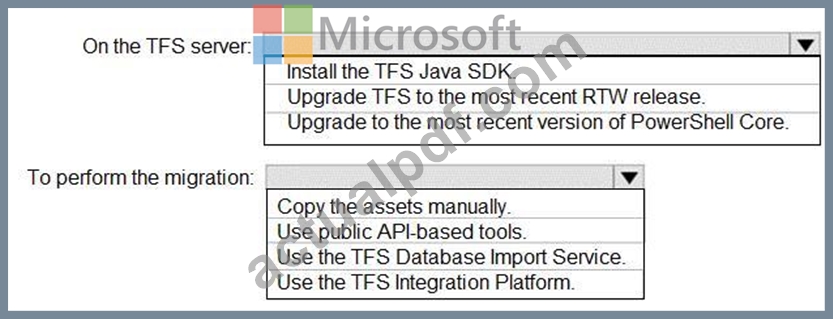
Answer:
Explanation: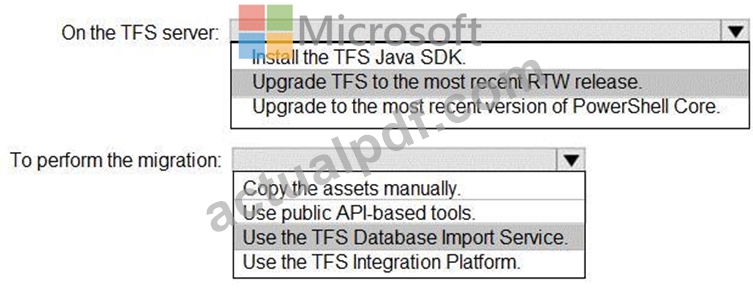
Box 1: Upgrade TFS to the most recent RTM release.
One of the major prerequisites for migrating your Team Foundation Server database is to get your database schema version as close as possible to what is currently deployed in Azure Devops Services.
Box 2: Use the TFS Database Import Service
In Phase 3 of your migration project, you will work on upgrading your Team Foundation Server to one of the supported versions for the Database Import Service in Azure Devops Services.
References: Team Foundation Server to Azure Devops Services Migration Guide
NEW QUESTION 122
Note: This question is part of a series of questions that present the same scenario. Each question in the series contains a unique solution that might meet the stated goals. Some question sets might have more than one correct solution, while others might not have a correct solution.
After you answer a question in this section, you will NOT be able to return to it. As a result, these questions will not appear in the review screen.
Your company has a project in Azure DevOps for a new web application.
You need to ensure that when code is checked in, a build runs automatically.
Solution: From the Continuous deployment trigger settings of the release pipeline, you enable the Pull request trigger setting.
Does this meet the goal?
- A. No
- B. Yes
Answer: B
Explanation:
Explanation/Reference:
Explanation:
On the Triggers tab you specify the events that will trigger the build. You can use the same build pipeline for both CI and scheduled builds.
References: https://docs.microsoft.com/en-us/azure/devops/pipelines/build/triggers
NEW QUESTION 123
Your company has four projects. The version control requirements for each project are shown in the following table.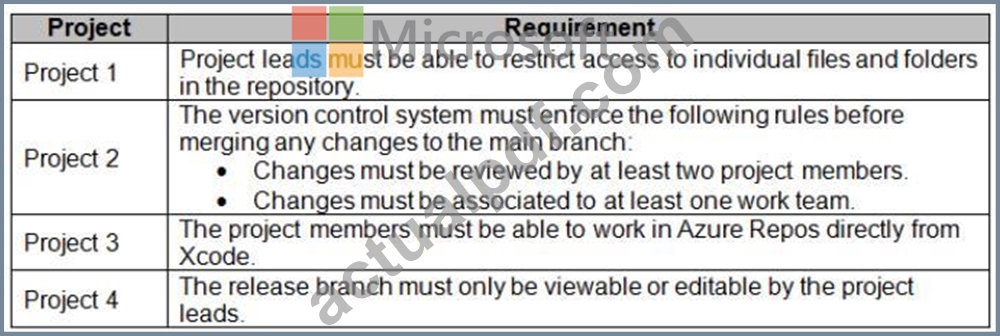
You plan to use Azure Repos for all the projects.
Which version control system should you use for each project? To answer, drag the appropriate version control systems to the correct projects. Each version control system may be used once, more than once, or not at all.
You may need to drag the split bar between panes or scroll to view content.
NOTE: Each correct selection is worth one point.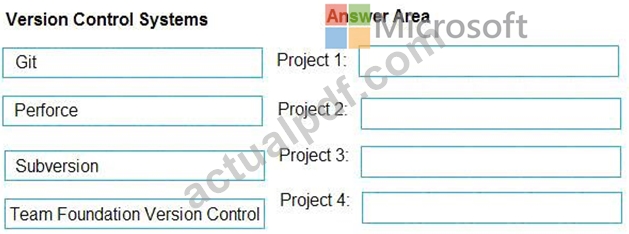
Answer:
Explanation: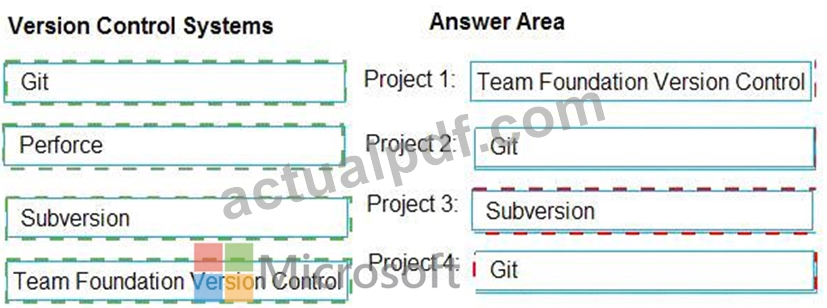
Explanation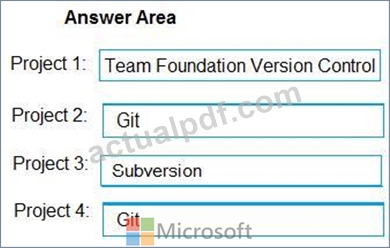
Box 1: Team Foundation Version Control
TFVC lets you apply granular permissions and restrict access down to a file level.
Box 2: Git
Git is the default version control provider for new projects. You should use Git for version control in your projects unless you have a specific need for centralized version control features in TFVC.
Box 3: Subversion
Note: Xcode is an integrated development environment (IDE) for macOS containing a suite of software development tools developed by Apple Box 4: Git Note: Perforce: Due to its multitenant nature, many groups can work on versioned files. The server tracks changes in a central database of MD5 hashes of file content, along with descriptive meta data and separately retains a master repository of file versions that can be verified through the hashes.
References:
https://searchitoperations.techtarget.com/definition/Perforce-Software
https://docs.microsoft.com/en-us/azure/devops/repos/git/share-your-code-in-git-xcode
https://docs.microsoft.com/en-us/azure/devops/repos/tfvc/overview
NEW QUESTION 124
You have a project in Azure DevOps named Contoso App that contains pipelines in Azure Pipelines for GitHub repositories. You need to ensure that developers receive Microsoft Teams notifications when there are failures in a pipeline of Contoso App. What should you run in Teams? To answer, select the appropriate options in the answer area. NOTE: Each correct selection is worth one point.
Answer:
Explanation:
Explanation
NEW QUESTION 125
Note: This question is part of a series of questions that present the same scenario. Each question in the series contains a unique solution that might meet the stated goals. Some question sets might have more than one correct solution, while others might not have a correct solution.
After you answer a question in this section, you will NOT be able to return to it. As a result, these questions will not appear in the review screen.
Your company uses Azure DevOps to manage the build and release processes for applications.
You use a Git repository for applications source control.
You need to implement a pull request strategy that reduces the history volume in the master branch.
Solution: You implement a pull request strategy that uses squash merges.
Does this meet the goal?
- A. No
- B. Yes
Answer: A
Explanation:
Instead use fast-forward merge.
Note:
Squash merge - Complete all pull requests with a squash merge, creating a single commit in the target branch with the changes from the source branch.
No fast-forward merge - This option merges the commit history of the source branch when the pull request closes and creates a merge commit in the target branch.
Reference:
https://docs.microsoft.com/en-us/azure/devops/repos/git/branch-policies
NEW QUESTION 126
Note: This question is part of a series of questions that present the same scenario. Each question in the series contains a unique solution that might meet the stated goals. Some question sets might have more than one correct solution, while others might not have a correct solution.
After you answer a question in this section, you will NOT be able to return to it. As a result, these questions will not appear in the review screen.
You manage a project in Azure DevOps.
You need to prevent the configuration of the project from changing over time.
Solution: Implement Continuous Integration for the project.
Does this meet the goal?
- A. No
- B. Yes
Answer: A
Explanation:
Instead implement Continuous Assurance for the project.
Reference:
https://azsk.azurewebsites.net/04-Continous-Assurance/Readme.html
NEW QUESTION 127
You manage build pipelines and deployment pipelines by using Azure DevOps.
Your company has a team of 500 developers. New members are added continual lo the team You need to automate me management of users and licenses whenever possible Which task must you perform manually?
- A. assigning entitlements
- B. procuring licenses
- C. adding users
- D. modifying group memberships
Answer: B
Explanation:
Explanation
References:
https://docs.microsoft.com/en-us/azure/devops/organizations/accounts/migrate-to-group-based-resource-managem
https://docs.microsoft.com/en-us/rest/api/azure/devops/memberentitlementmanagement/?view=azure-devops-res
NEW QUESTION 128
You plan to provision a self-hosted Linux agent
Which authentication mechanism should you use to register the self-hosted agent?
- A. certificate
- B. personal access token (PAT)
- C. Alternate credentials
- D. SSH key
Answer: B
NEW QUESTION 129
Your company has a project in Azure DevOps.
You need to ensure that when there are multiple builds pending deployment, only the most recent build is deployed.
What should you use?
- A. deployment conditions
- B. deployment queue settings
- C. release gates
- D. pull request triggers
Answer: B
Explanation:
The options you can choose for a queuing policy are:
* Number of parallel deployments
* If you specify a maximum number of deployments, two more options appear:
- Deploy all in sequence
- Deploy latest and cancel the others: Use this option if you are producing releases faster than builds, and you only want to deploy the latest build.
Incorrect Answers:
C: Release gates allow automatic collection of health signals from external services, and then promote the release when all the signals are successful at the same time or stop the deployment on timeout. Typically, gates are used in connection with incident management, problem management, change management, monitoring, and external approval systems.
References:
https://docs.microsoft.com/en-us/azure/devops/pipelines/process/stages?tabs=classic&view=azure- devops#queuing-policies
NEW QUESTION 130
......
A fully updated 2021 AZ-400 Exam Dumps exam guide from training expert ActualPDF: https://www.actualpdf.com/AZ-400_exam-dumps.html
Practice To AZ-400 - ActualPDF Remarkable Practice On your Microsoft Azure DevOps Solutions Exam: https://drive.google.com/open?id=1zbugPlOu3UKDjaEYU5MBzOtplrp1dzR9
