

Pass CompTIA Cloud+ CV0-003 exam [Sep 04, 2024] Updated 404 Questions
CompTIA CV0-003 Actual Questions and 100% Cover Real Exam Questions
CompTIA CV0-003 exam covers a range of cloud computing topics, including cloud architecture and design, security, deployment, and automation. CV0-003 exam consists of 90 multiple-choice and performance-based questions, which are designed to test candidates' knowledge and skills in cloud computing. CV0-003 exam is available in English, Japanese, and Portuguese, and candidates have 90 minutes to complete the exam.
The foundation of the CompTIA CV0-003 exam is focused on the understanding of cloud architecture and infrastructure. Candidates will be tested on their technical skills required for designing, deploying, securing, and maintaining cloud computing solutions.
NEW QUESTION # 146
A cloud architect is designing the VPCs for a new hybrid cloud deployment. The business requires the following:
High availability
Horizontal auto-scaling
60 nodes peak capacity per region
Five reserved network IP addresses per subnet
/24 range
Which of the following would BEST meet the above requirements?
- A. Create three /25 subnets in different regions
- B. Create two /26 subnets in different regions
- C. Create three /27 subnets in different regions
- D. Create two /25 subnets in different regions
- E. Create three /26 subnets in different regions
- F. Create two /27 subnets in different regions
Answer: B
NEW QUESTION # 147
An organization has the following requirements that need to be met when implementing cloud services:
SSO to cloud infrastructure
On-premises directory service
RBAC for IT staff
Which of the following cloud models would meet these requirements?
- A. Hybrid
- B. Public
- C. Multitenant
- D. Community
Answer: A
Explanation:
A hybrid cloud is a type of cloud deployment model that combines two or more different types of clouds, such as public, private, or community clouds, into a single integrated environment. A hybrid cloud can meet the requirements for implementing cloud services with SSO to cloud infrastructure, on-premises directory service, and RBAC for IT staff, as it can provide flexibility, scalability, and security for cloud-based and on-premises resources. A hybrid cloud can also enable seamless and secure access to cloud infrastructure using SSO with directory service federation, as well as granular and consistent control over IT staff permissions using RBAC across different cloud environments. Reference: CompTIA Cloud+ Certification Exam Objectives, page 8, section 1.2
NEW QUESTION # 148
Company A has acquired Company B and is in the process of integrating their cloud resources. Company B needs access to Company A's cloud resources while retaining its IAM solution.
Which of the following should be implemented?
- A. Multifactor authentication
- B. Identity federation
- C. Directory service
- D. Single sign-on
Answer: B
NEW QUESTION # 149
A systems administrator is trying to reduce storage consumption. Which of the following file types would benefit the MOST from compression?
- A. User backups
- B. Relational database
- C. Mail database
- D. System files
Answer: A
Explanation:
User backups are the file type that would benefit the most from compression to reduce storage consumption. Compression is a process of reducing the size of data by removing redundant or unnecessary information or using algorithms to encode data more efficiently. Compression can save storage space and bandwidth, but it may also affect the quality or performance of data depending on the compression method and ratio. User backups are typically large files that contain various types of data, such as documents, images, videos, etc., that can be compressed without significant loss of quality or functionality.
NEW QUESTION # 150
A cloud administrator has created a new asynchronous workflow lo deploy VMs to the cloud in bulk. When the workflow is tested for a single VM, it completes successfully. However, if the workflow is used to create 50 VMs at once, the job fails. Which of the following is the MOST likely cause of the issue? (Choose two.)
- A. Billing issues with the cloud provider
- B. Disabled autoscaling
- C. Expired API token
- D. Incorrect permissions
- E. Insufficient storage
- F. No connectivity to the public cloud
Answer: C,E
Explanation:
The most likely causes of the issue where the new asynchronous workflow fails to create 50 VMs at once in the public cloud are insufficient storage and expired API token. Insufficient storage means that there is not enough disk space available in the public cloud to accommodate all the VMs that are being created simultaneously. This could result in errors or failures during the provisioning process. Expired API token means that the authentication credential that is used by the workflow to communicate with the public cloud service has expired or become invalid. This could result in errors or failures during the API calls or requests. Reference: CompTIA Cloud+ Certification Exam Objectives, Domain 4.0 Troubleshooting, Objective 4.5 Given a scenario, troubleshoot automation/orchestration issues.
NEW QUESTION # 151
After a hardware upgrade on a private cloud system, the systems administrator notices a considerable drop in network performance. Which of the following is MOST likely the cause?
- A. The driver
- B. The cluster placement
- C. The CPU
- D. The memory
Answer: A
Explanation:
Explanation
The driver is the most likely cause of the drop in network performance after a hardware upgrade on a private cloud system. A driver is a software component that enables communication and interaction between hardware devices and operating systems or applications. A driver may need to be updated or reinstalled after a hardware upgrade to ensure compatibility and functionality. If the driver is outdated, missing, or corrupted, it may affect the network performance of the system.
NEW QUESTION # 152
Which of the following will provide a systems administrator with the MOST information about potential attacks on a cloud IaaS instance?
- A. Network flows
- B. FIM
- C. HIDS
- D. Software firewall
Answer: C
Explanation:
HIDS (Host-based Intrusion Detection System) is the tool that will provide the administrator with the most information about potential attacks on a cloud IaaS instance. HIDS is a software or agent that monitors and analyzes the activities and events on a host system or device, such as a cloud instance. HIDS can detect and alert on any malicious or anomalous behavior, such as unauthorized access, malware infection, configuration changes, etc., that may indicate an attack or compromise.
NEW QUESTION # 153
A SaaS customer reports that no one can access the application portal. After some troubleshooting, the cloud administrator finds a problem and provides a remedy by restarting the cluster. After documenting the solution, the support case is closed. Multiple tenants lose access to their hosts the following day.
Which of the following troubleshooting steps did the administrator miss?
- A. Establish a theory.
- B. Identify the problem.
- C. Test the theory.
- D. Establish a plan of action.
- E. Verify full system functionality.
Answer: E
NEW QUESTION # 154
Users of an enterprise application, which is configured to use SSO, are experiencing slow connection times. Which of the following should be done to troubleshoot the issue?
- A. * Evaluate the OS ACLs.
* Upgrade the router firmware.
* Increase the memory of the router. - B. * Perform a memory dump of the OS.
* Analyze the memory dump.
* Upgrade the host CPU to a higher clock speed CPU. - C. * Perform a packet capture during authentication.
* Validate the load-balancing configuration.
* Analyze the network throughput of the load balancer. - D. * Analyze the storage system IOPS.
* Increase the storage system capacity.
* Replace the storage system disks to SSD.
Answer: D
NEW QUESTION # 155
A cloud administrator has built a new private cloud environment and needs to monitor all computer, storage, and network components of the environment.
Which of the following protocols would be MOST useful for this task?
- A. SMTP
- B. SNMP
- C. SCP
- D. SFTP
Answer: B
NEW QUESTION # 156
An enterprise recently upgraded the memory of its on-premises VMs from 8GB to 16GB.
However, users are not experiencing any performance benefit. Which of the following is the MOST likely reason?
- A. Dynamic memory allocation
- B. Memory mismatch error
- C. Operating system memory limit
- D. Insufficient memory on the hypervisor
Answer: D
NEW QUESTION # 157
An administrator is unable to ping anything on the network, as the ping command immediately returns an error. Which of the following commands should the administrator use FIRST to troubleshoot this issue?
- A. netstat -o
- B. route
- C. nslookup
- D. ipconfig
Answer: D
NEW QUESTION # 158
An organization is hosting its dedicated email infrastructure with unlimited mailbox creation capability. The management team would like to migrate to a SaaS-based solution. Which of the following must be considered before the migration?
- A. The number of network links the SaaS provider has
- B. The SaaS provider's licensing model
- C. The number of servers the SaaS provider has
- D. The SaaS provider's reputation
Answer: B
NEW QUESTION # 159
An organization hosts an ERP database in on-premises infrastructure. A recommendation has been made to migrate the ERP solution to reduce operational overhead in the maintenance of the data center. Which of the following should be considered when migrating this on-premises database to DBaaS?
- A. * Database application version compatibility
* Database IOPS values
* Database storage utilization - B. * Physical database server operating system
* Physical database server memory configuration
* Physical database server CPU frequency - C. * Database total user count
* Database total number of tables
* Database total number of storage procedures - D. * Physical database server CPU cache value
* Physical database server DAS type
* Physical database server network I/O
Answer: A
Explanation:
When migrating an on-premises database to DBaaS, it is important to consider the database application version compatibility, the database IOPS values, and the database storage utilization. These factors can affect the performance, functionality, and cost of the migration. Database application version compatibility refers to the ability of the DBaaS provider to support the same or compatible version of the database software as the on-premises database. This can ensure that the database features, syntax, and behavior are consistent and compatible across the environments. Database IOPS values refer to the input/output operations per second that the database performs. This can indicate the workload and throughput of the database, and help determine the appropriate size and configuration of the DBaaS instance. Database storage utilization refers to the amount of disk space that the database consumes. This can affect the cost and scalability of the DBaaS service, and help optimize the storage allocation and backup strategies. Reference := CompTIA Cloud+ source documents or study guide CompTIA Cloud+ Certification Exam Objectives, Domain 2.0: Deployment, Objective 2.1: Given a scenario, execute and implement solutions using appropriate cloud migration tools and methods.
Migrate your relational databases to Azure - .NET | Microsoft Learn, Migrate On-premises Tablespaces to DBaaS Database Using Cross-Platform Tablespace Transport Migrating On-Premises Databases to the DBaaS Database Using RMAN - Oracle, Overview
NEW QUESTION # 160
A SAN that holds VM files is running out of storage space.
Which of the following will BEST increase the amount of effective storage on the SAN?
- A. Enable encryption
- B. Increase IOPS
- C. Convert the SAN from RAID 50 to RAID 60
- D. Configure deduplication
Answer: D
Explanation:
Explanation
Deduplication is a type of data compression technique that eliminates redundant or duplicate data blocks or segments in a storage system or device. Configuring deduplication can help increase the amount of effective storage on a SAN that holds VM files and is running out of storage space, as it can reduce the storage space consumption and increase the storage space utilization by storing only unique data blocks or segments.
Configuring deduplication can also improve performance and efficiency, as it can speed up data transfer and backup processes and save network bandwidth and power consumption. References: CompTIA Cloud+ Certification Exam Objectives, page 9, section 1.4
NEW QUESTION # 161
After initial stress testing showed that a platform performed well with the specification of a single
32 vCPU node, which of the following will provide the desired service with the LOWEST cost and downtime?
- A. Three to six 8 vCPU nodes autoscaling group
- B. One 32 vCPU node with CDN caching
- C. Two 8 vCPU nodes with load balancing
- D. Four 8 vCPU nodes with DNS round robin
Answer: C
NEW QUESTION # 162
Company A has acquired Company B and is in the process of integrating their cloud resources. Company B needs access to Company A's cloud resources while retaining its IAM solution.
Which of the following should be implemented?
- A. Multifactor authentication
- B. Identity federation
- C. Directory service
- D. Single sign-on
Answer: B
Explanation:
Identity federation is a type of authentication mechanism that allows users to access multiple systems or applications across different domains or organizations with a single login credential. Identity federation can help integrate the cloud resources of Company A and Company B after Company A has acquired Company B, as it can enable seamless and secure access to both companies' cloud resources using the same IAM solution. Identity federation can also improve user convenience, productivity, and security, as it can simplify the login process, reduce login errors, and enhance password management. Reference: CompTIA Cloud+ Certification Exam Objectives, page 14, section 2.7
NEW QUESTION # 163
A developer is no longer able to access a public cloud API deployment, which was working ten minutes prior.
Which of the following is MOST likely the cause?
- A. Depleted network bandwidth
- B. Invalid API request
- C. API provider rate limiting
- D. Invalid API token
Answer: D
NEW QUESTION # 164
A company wants to check its infrastructure and application for security issues regularly. Which of the following should the company implement?
- A. Penetration testing
- B. Vulnerability testing
- C. Regression testing
- D. Performance testing
Answer: A
Explanation:
https://pure.security/services/technical-assurance/external-penetration-testing/
NEW QUESTION # 165
A systems administrator is using VMs to deploy a new solution that contains a number of application VMs.
Which of the following would provide high availability to the application environment in case of hypervisor failure?
- A. Affinity rules
- B. Live migration
- C. Anti-affinity rules
- D. Cold migration
Answer: C
Explanation:
Explanation
Anti-affinity rules are rules or policies that prevent two or more VMs from running on the same host or cluster in a cloud environment. Anti-affinity rules can provide high availability to an application environment in case of hypervisor failure, as they can distribute or separate the application VMs across different hosts or clusters and avoid having a single point of failure. Anti-affinity rules can also improve performance and reliability, as they can reduce contention and load by balancing the resource utilization across multiple hosts or clusters.
References: CompTIA Cloud+ Certification Exam Objectives, page 10, section 1.5
NEW QUESTION # 166
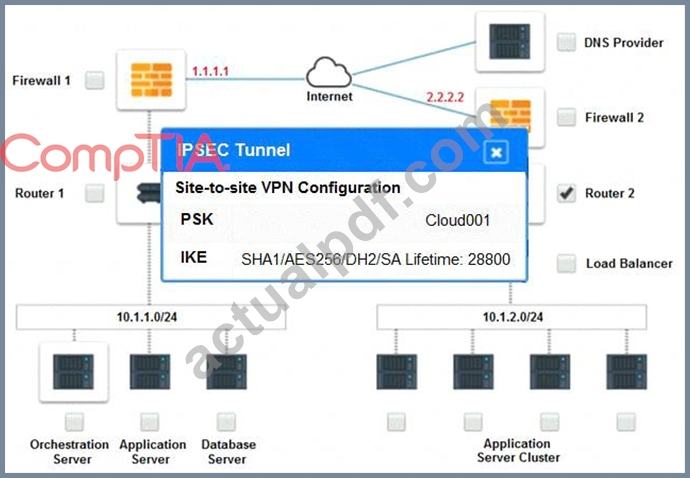
A company has decided to scale its e-commerce application from its corporate datacenter to a commercial cloud provider to meet an anticipated increase in demand during an upcoming holiday.
The majority of the application load takes place on the application server under normal conditions. For this reason, the company decides to deploy additional application servers into a commercial cloud provider using the on-premises orchestration engine that installs and configures common software and network configurations.
The remote computing environment is connected to the on-premises datacenter via a site-to-site IPSec tunnel.
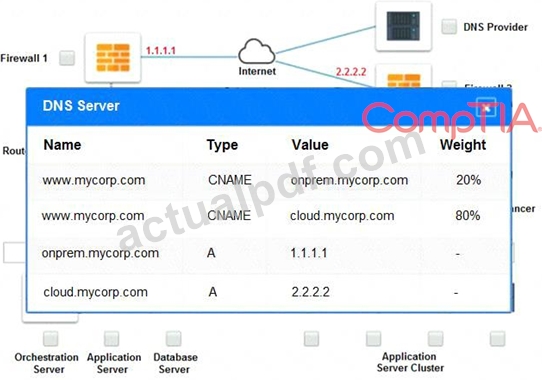
The external DNS provider has been configured to use weighted round-robin routing to load balance connections from the Internet.
During testing, the company discovers that only 20% of connections completed successfully.
INSTRUCTIONS
Review the network architecture and supporting documents and fulfill these requirements:
Part 1:
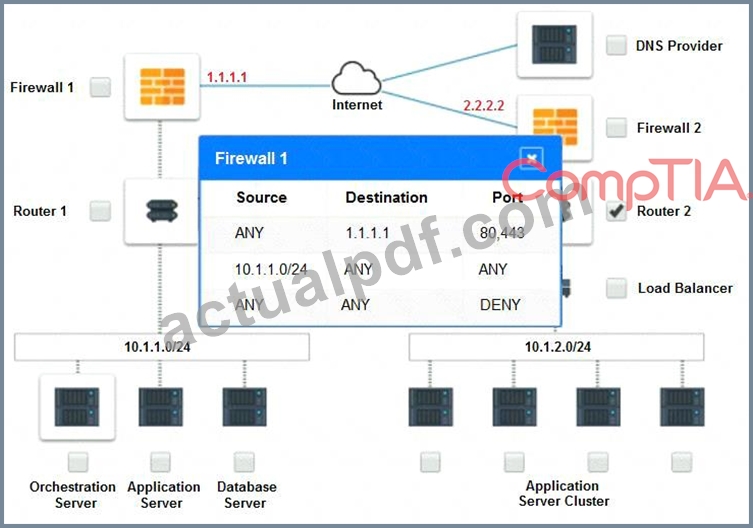
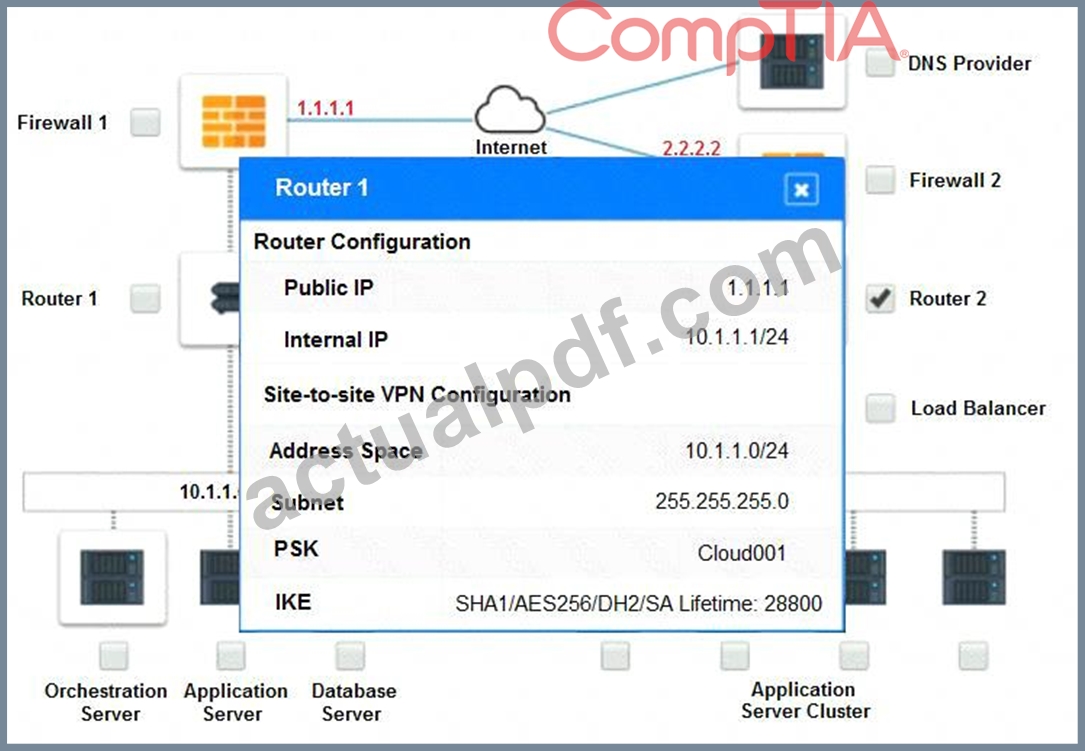
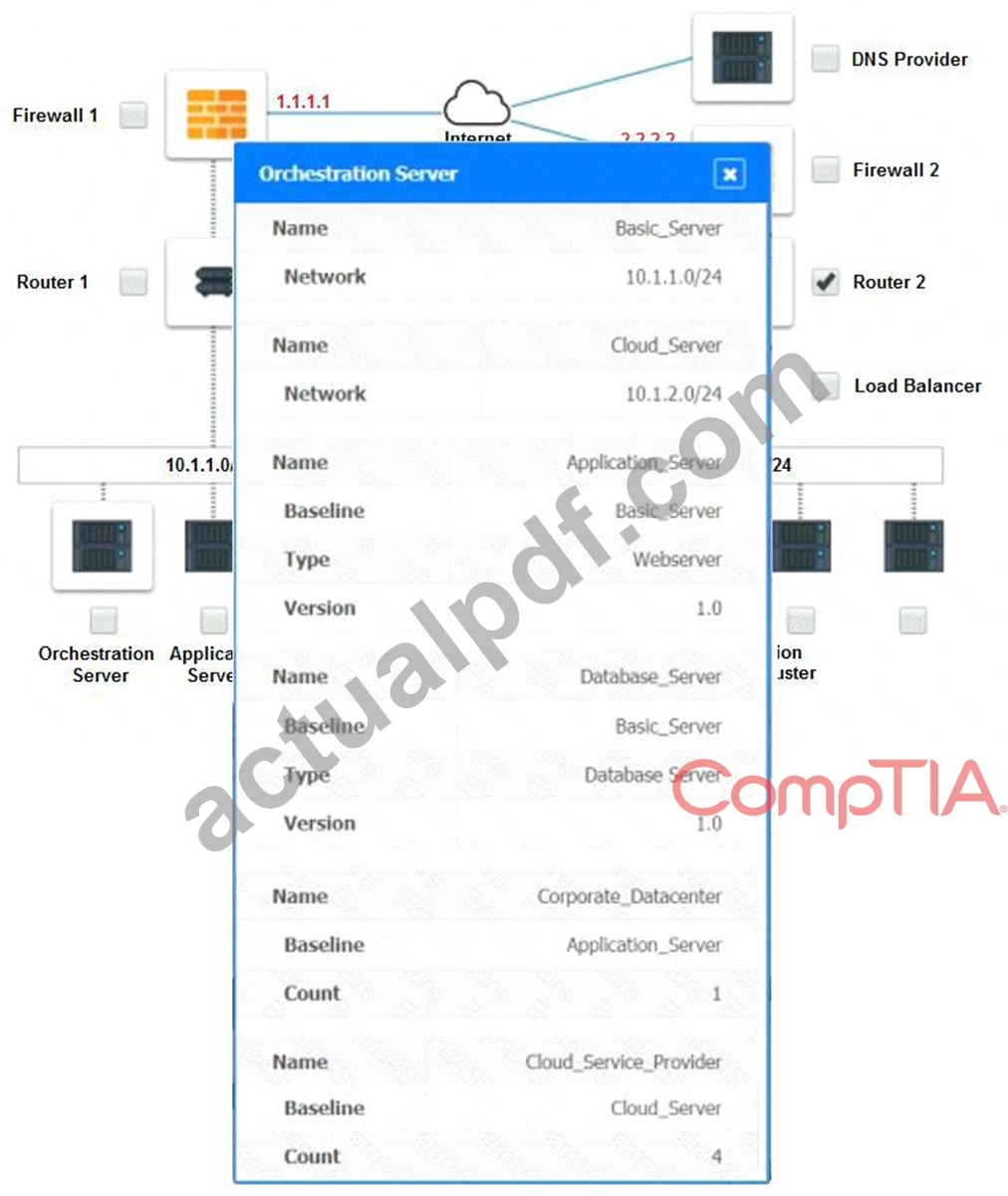
Analyze the configuration of the following components: DNS, Firewall 1, Firewall 2, Router 1, Router 2, VPN and Orchestrator Server.
Identify the problematic device(s).
Part 2:
Identify the correct options to provide adequate configuration for hybrid cloud architecture.
If at any time you would like to bring back the initial state of the simulation, please click the Reset All button.
Part 1:
Cloud Hybrid Network Diagram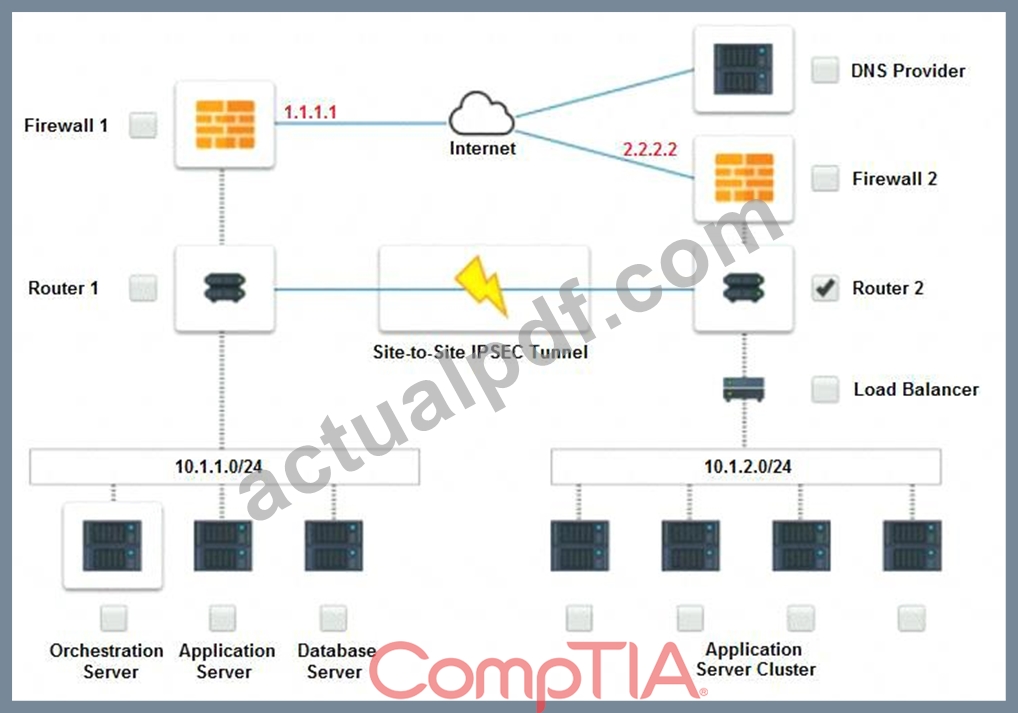
Part 2:
Only select a maximum of TWO options from the multiple choice question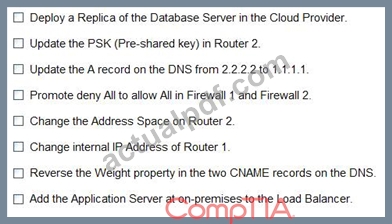
Answer:
Explanation:
See explanation below.
Explanation
Part 1: Router 2
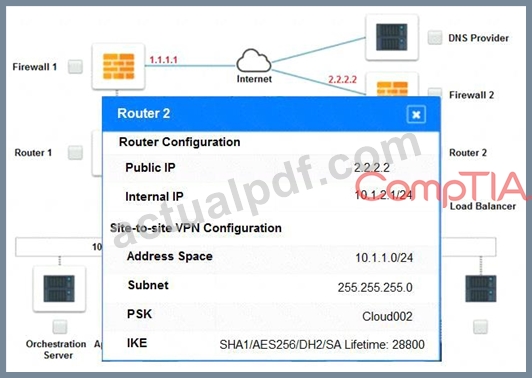
The problematic device is Router 2, which has an incorrect configuration for the IPSec tunnel. The IPSec tunnel is a secure connection between the on-premises datacenter and the cloud provider, which allows the traffic to flow between the two networks. The IPSec tunnel requires both endpoints to have matching parameters, such as the IP addresses, the pre-shared key (PSK), the encryption and authentication algorithms, and the security associations (SAs) .
According to the network diagram and the configuration files, Router 2 has a different PSK and a different address space than Router 1. Router 2 has a PSK of "1234567890", while Router 1 has a PSK of
"0987654321". Router 2 has an address space of 10.0.0.0/8, while Router 1 has an address space of
192.168.0.0/16. These mismatches prevent the IPSec tunnel from establishing and encrypting the traffic between the two networks.
The other devices do not have any obvious errors in their configuration. The DNS provider has two CNAME records that point to the application servers in the cloud provider, with different weights to balance the load.
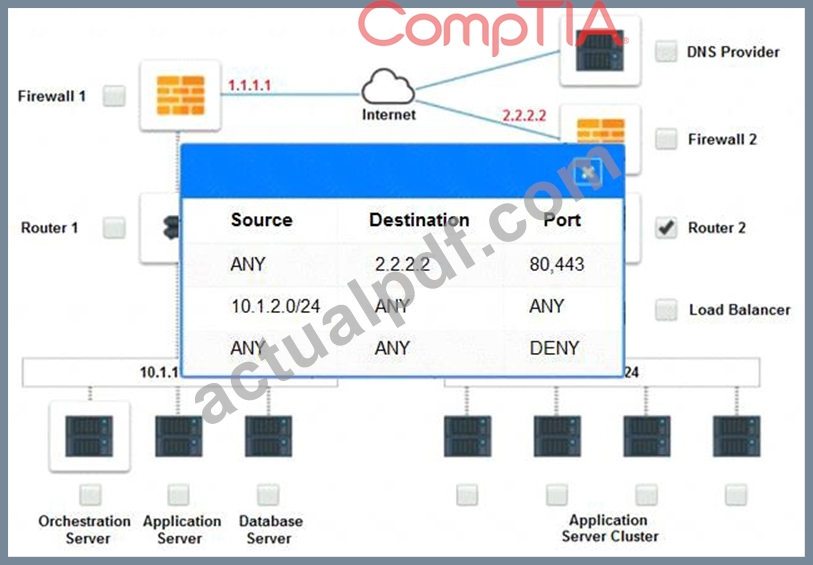
The firewall rules allow the traffic from and to the application servers on port 80 and port 443, as well as the traffic from and to the VPN server on port 500 and port 4500. The orchestration server has a script that installs and configures the application servers in the cloud provider, using the DHCP server to assign IP addresses.
Part 2:
The correct options to provide adequate configuration for hybrid cloud architecture are:
Update the PSK in Router 2.
Change the address space on Router 2.
These options will fix the IPSec tunnel configuration and allow the traffic to flow between the on-premises datacenter and the cloud provider. The PSK should match the one on Router 1, which is "0987654321". The address space should also match the one on Router 1, which is 192.168.0.0/16.
B. Update the PSK (Pre-shared key in Router2)
E. Change the Address Space on Router2
NEW QUESTION # 167
......
Introduction to Cloud Architecture
The system architecture of the software systems has Cloud architecture which is involved in the delivery of cloud computing (e.g. hardware, software) as designed by a cloud architect who typically works for a cloud computing provider. It consists of multiple cloud components communicating over application programming interfaces (usually web services). Cloud architecture extends to the client, where the network infrastructure (Internet/Intranet), computer hardware, and operating system from a client-server configuration. Data centers are connected, each containing multiple servers. CompTIA CV0-003 Dumps will help you to get certified in first attempt. If you fail in the real exam paper, so we have a refund policy. The Cloud Infrastructure is provided by third parties and can be accessed through various devices such as computers, tablets, smartphones, etc.
Cloud architecture encompasses the complete set of hardware and software components involved in delivering the “as-a-service” model of computing.
The Cloud Architecture framework includes the following six principles:
Design for Business
Manage Services, Not Servers
Automate Everything
Design for Scale
Design for Security
CompTIA CV0-003 Real 2024 Braindumps Mock Exam Dumps: https://www.actualpdf.com/CV0-003_exam-dumps.html
CV0-003 Free Exam Questions and Answers PDF Updated on Sep-2024: https://drive.google.com/open?id=1ksigJFCxCHOKGoJBVytKIEolRzCjQSwf
